History of Hubble Space Telescope (HST)
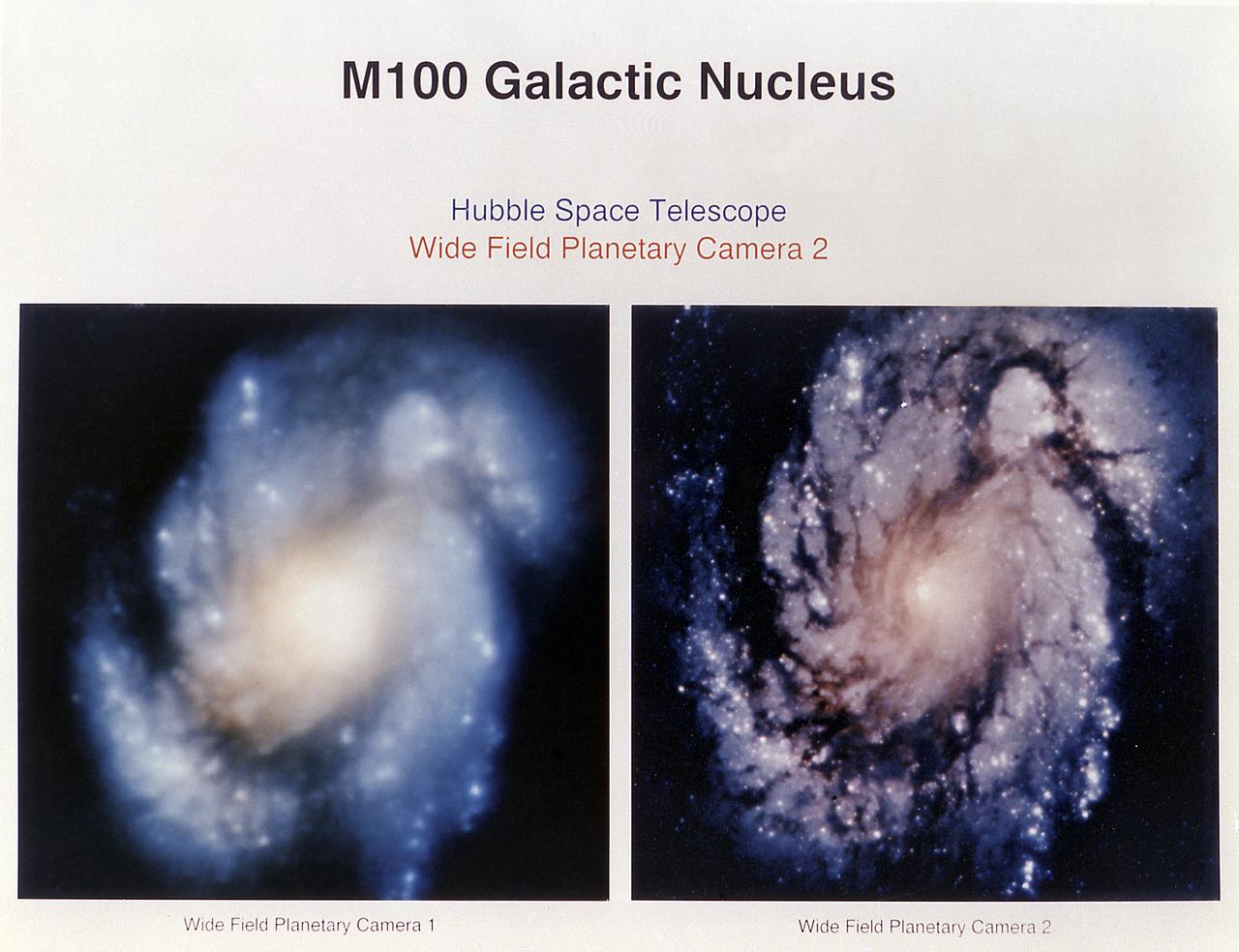
A comparison image of the M100 Galactic Nucleus, taken by the Hubble Space Telescope (HST) Wide Field Planetary Camera-1 (WF/PC1) and Wide Field Planetary Camera-2 (WF/PC2). The HST was placed in a low-Earth orbit by the Space Shuttle Discovery, STS-31 mission, in April 1990. Two months after its deployment in space, scientists detected a 2-micron spherical aberration in the primary mirror of the HST that affected the telescope's ability to focus faint light sources into a precise point. This imperfection was very slight, one-fiftieth of the width of a human hair. During four spacewalks, the STS-61 crew replaced the solar panel with its flexing problems; the WF/PC1 with the WF/PC2, with built-in corrective optics; and the High-Speed Photometer with the Corrective Optics Space Telescope Axial Replacement (COSTAR), to correct the aberration for the remaining instruments. The purpose of the HST, the most complex and sensitive optical telescope ever made, is to study the cosmos from a low-Earth orbit for 15 years or more. The HST provides fine detail imaging, produces ultraviolet images and spectra, and detects very faint objects.