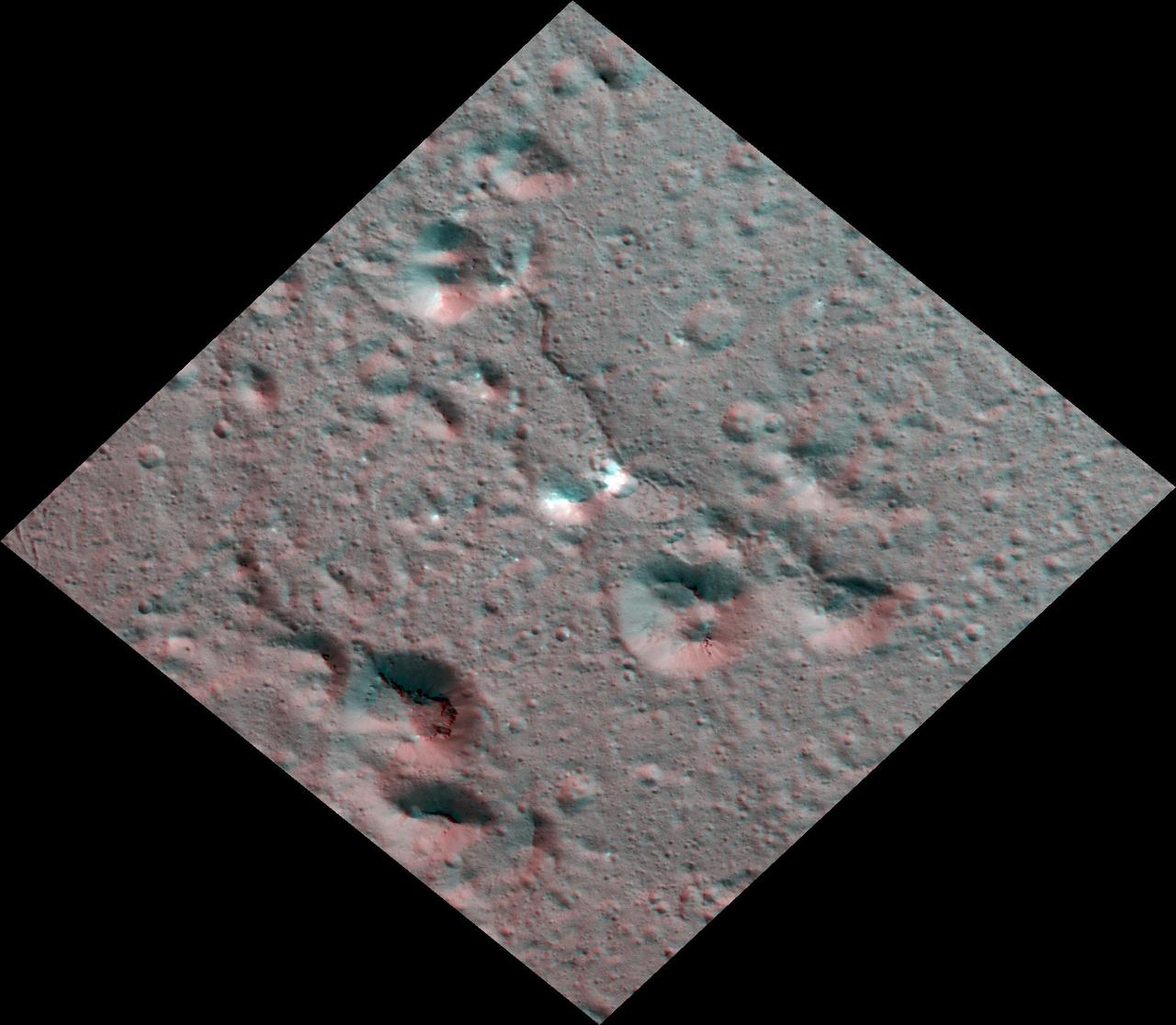
Dawn Stereo Anaglyph of Hydrothermal Deposits at Occator Crater, Ceres
The Dawn spacecraft captured these stereo images of Occator Crater on the dwarf planet Ceres in 2018. This view is part of a mosaic of about 50 framing camera images used to construct this anaglyph view (which requires red-blue stereo glasses for viewing) of part of the eastern floor of the crater. This area is approximately 5 miles (8.5 kilometers) wide and features bright carbonate deposits of the Vinalia Faculae formation on top of the ropey textured lobate floor impact melt deposit. Stereo views of Vinalia Faculae illustrate the complex relationship between the thin carbonates and the underlying impact deposits. The spatial resolution of the stereo images is about 11 feet (3.5 meters) per pixel. Occator crater, named after the Roman god of the agricultural practice of harrowing, is about 57 miles (92 kilometers) in diameter. The conclusion of Dawn's mission operations was Oct. 31, 2018, when the spacecraft depleted its hydrazine used for attitude control. This image was produced by Dr. Paul Schenk at the Lunar and Planetary Institute in Houston. https://photojournal.jpl.nasa.gov/catalog/PIA24063