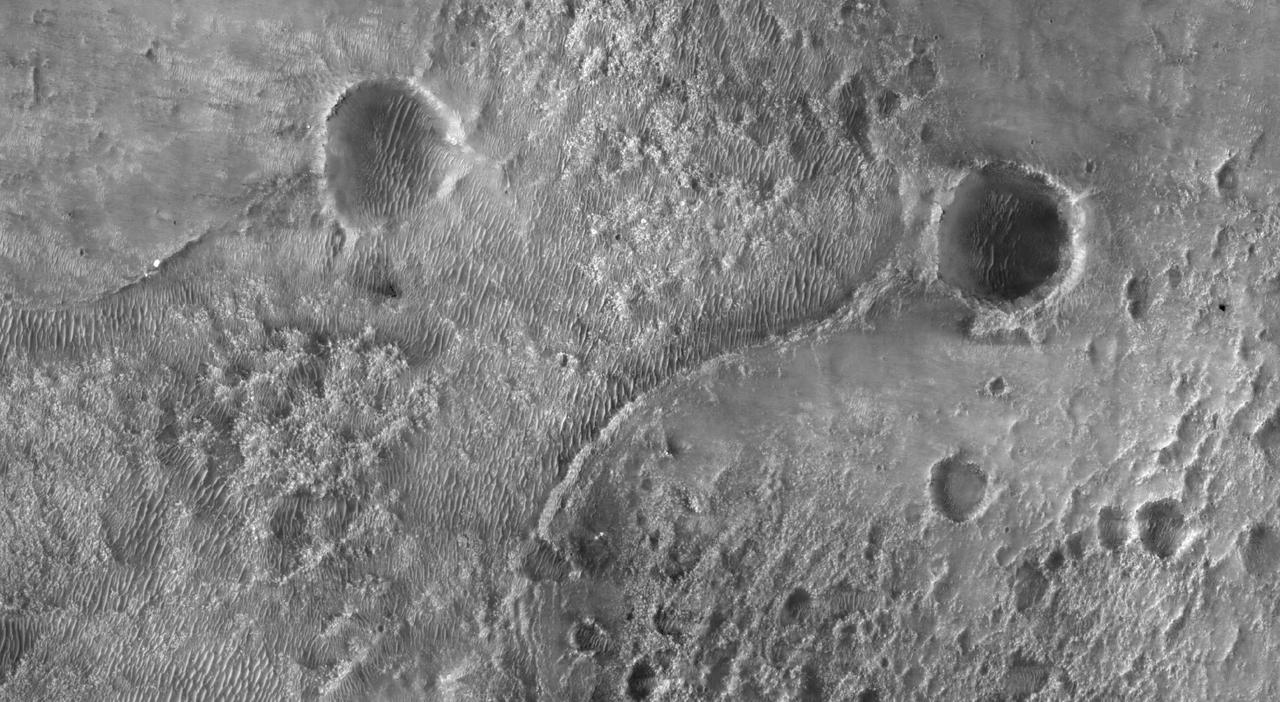
Perseverance and Mars 2020 Spacecraft Components on the Surface
This first image of NASA's Perseverance Rover on the surface of Mars from the High Resolution Imaging Experiment (HiRISE) camera aboard NASA's Mars Reconnaissance Orbiter (MRO) shows the many parts of the Mars 2020 mission landing system that got the rover safely on the ground. The image was taken on Feb. 19, 2021. The rover itself sits at the center of a blast pattern created by the hovering descent stage that lowered it there using the sky crane maneuver. The descent stage flew off to crash at a safe distance, creating a V-shaped debris pattern that points back toward the rover. Earlier in the landing sequence, Perseverance jettisoned its heat shield and parachute, which can be seen on the surface in the separate locations illustrated. These objects are highly visible on the surface of Mars now but will become dustier with time and slowly fade into the background over years. HiRISE will continue to image the Perseverance landing site to track the progress of the rover and changes with the other pieces of hardware that accompanied it. A key objective for Perseverance's mission on Mars is astrobiology, including the search for signs of ancient microbial life. The rover will characterize the planet's geology and past climate, pave the way for human exploration of the Red Planet, and be the first mission to collect and cache Martian rock and regolith (broken rock and dust). Subsequent NASA missions, in cooperation with ESA (European Space Agency), would send spacecraft to Mars to collect these sealed samples from the surface and return them to Earth for in-depth analysis. The Mars 2020 Perseverance mission is part of NASA's Moon to Mars exploration approach, which includes Artemis missions to the Moon that will help prepare for human exploration of the Red Planet. https://photojournal.jpl.nasa.gov/catalog/PIA24333