
Stellar Incubators Seen Cooking up Stars
Open

U. S. and Japan Space Agreement Signing
Open

U. S. and Japan Space Agreement Signing
Open

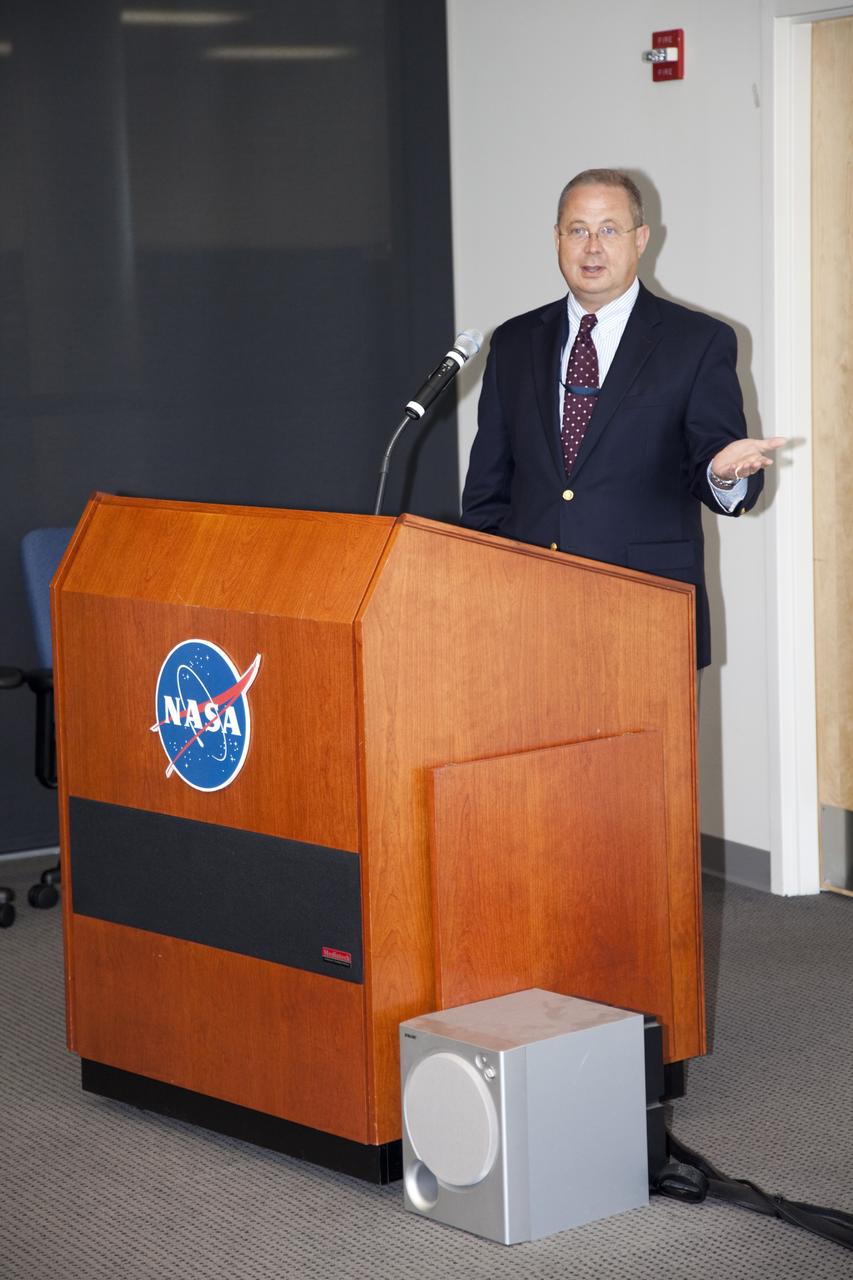
KENNEDY SPACE CENTER, FLA. - Alan Thirkettle, International Space Station Program manager for Node 2, European Space Agency (ESA), speaks to guests and the media gathered in the Space Station Processing Facility at a ceremony highlighting the arrival of two major components of the International Space Station. NASA's Node 2, built by the European Space Agency (ESA) in Italy, arrived at KSC on June 1. It will be the next pressurized module installed on the Station. The pressurized module of the Japanese Experiment Module (JEM), named "Kibo" (Hope), arrived at KSC on June 4. It is Japan's primary contribution to the Station. The ceremony held today included the official transfer of ownership signing of Node 2 between the ESA and NASA.. Emceed by Lisa Malone, deputy director of External Relations and Business Development at KSC, the ceremony also included these speakers: Center Director Roy Bridges Jr.; NASA’s Michael C. Kostelnik, deputy associate administrator for International Space Station and Shuttle Programs and William Gerstenmaier, International Space Station Program manager; Andrea Lorenzoni, International Space Station Program manager for Node 2, Italian Space Agency; and Kuniaki Shiraki, JEM Project manager, National Aerospace and Development Agency of Japan.
Open

200802200004HQ Space Shuttle Atlantis (STS-122) Lands
Open

Landing of STS-71 space shuttle Atlantis
Open

STS-121 Space Shuttle Processing Update
Open

200802200001HQ Space Shuttle Atlantis (STS-122) Lands
Open

NASA Stennis Hosts Space Flight Awareness Meeting
Open

NASA's Planetary Radar Reveals Peanut Shape of Asteroid 1997 QK1
Open

KENNEDY SPACE CENTER, FLA. - The container transport ship carrying the JEM Pressurized Module arrives at Port Canaveral, Fla. The National Space Development Agency of Japan (NASDA) built the laboratory at the Tsukuba Space Center near Tokyo. The Pressurized Module is the first element of the JEM, Japan’s primary contribution to the space station, to be delivered to KSC. It will enhance the unique research capabilities of the orbiting complex by providing an additional shirt-sleeve environment for astronauts to conduct science experiments. The JEM also includes two logistics modules, an exposed pallet for space environment experiments and a robotic manipulator system that are still under construction in Japan. The various JEM components will be assembled in space over the course of three space shuttle missions.
Open

KENNEDY SPACE CENTER, FLA. - Dignitaries, invited guests, space center employees, and the media gather for a dedication and ribbon-cutting ceremony for the Space Life Sciences Lab hosted by NASA-Kennedy Space Center and the state of Florida at the new lab. Completed in August, the facility encompasses more than 100,000 square feet and was formerly known as the Space Experiment Research and Processing Laboratory or SERPL. The state, through the Florida Space Authority, built the research lab which is host to NASA, NASA’s Life Sciences Services contractor Dynamac Corp., Bionetics Corp., and researchers from the University of Florida. Dynamac Corp. leases the facility. The Florida Space Research Institute is responsible for gaining additional tenants from outside the NASA community.
Open

KENNEDY SPACE CENTER, FLA. - The Japanese Experiment Module (JEM) Pressurized Module is ready to be offloaded from the ship that carried it from Japan. The National Space Development Agency of Japan (NASDA) built the laboratory at the Tsukuba Space Center near Tokyo. The Pressurized Module is the first element of the JEM, Japan’s primary contribution to the space station, to be delivered to KSC. It will enhance the unique research capabilities of the orbiting complex by providing an additional shirt-sleeve environment for astronauts to conduct science experiments. The JEM also includes two logistics modules, an exposed pallet for space environment experiments and a robotic manipulator system that are still under construction in Japan. The various JEM components will be assembled in space over the course of three space shuttle missions.
Open

KENNEDY SPACE CENTER, FLA. - NASA's Associate Administrator for Space Flight William Readdy (left) and Evelyn Husband, widow of astronaut Rick Husband, place a ceremonial wreath at the Space Mirror Memorial at the Kennedy Space Center Visitor Complex. During this dedication ceremony, the names of the STS-107 astronauts who lost their lives during the Columbia accident -- Rick Husband, Willie McCool, Laurel Clark, Michael Anderson, David Brown, Kalpana Chawla, and Ilan Ramon -- join the names of 17 other space heroes who gave their lives for the U.S. space program. The "Space Mirror," 42 1/2 feet high by 50 feet wide, illuminates the names of the fallen astronauts cut through the monument's black granite surface.
Open

KENNEDY SPACE CENTER, FLA. - Workers in the Space Station Processing Facility attach an overhead crane to the Japanese Experiment Module (JEM) pressure module inside its canister. The module will be removed and transferred to a work stand in the Space Station Processing Facility. A research laboratory, the pressurized module is the first element of the JEM, named "Kibo" (Hope), to be delivered to KSC. The National Space Development Agency of Japan (NASDA) developed the laboratory at the Tsukuba Space Center near Tokyo and is Japan's primary contribution to the Station. It will enhance the unique research capabilities of the orbiting complex by providing an additional environment for astronauts to conduct science experiments. The JEM also includes an exposed facility (platform) for space environment experiments, a robotic manipulator system, and two logistics modules. The various JEM components will be assembled in space over the course of three Shuttle missions.
Open

KENNEDY SPACE CENTER, FLA. - Capt. Winston Scott, executive director of the Florida Space Authority, speaks at a dedication and ribbon-cutting ceremony for the Space Life Sciences Lab hosted by NASA-Kennedy Space Center and the state of Florida at the new lab. Completed in August, the facility encompasses more than 100,000 square feet and was formerly known as the Space Experiment Research and Processing Laboratory or SERPL. The state, through the Florida Space Authority, built the research lab which is host to NASA, NASA’s Life Sciences Services contractor Dynamac Corp., Bionetics Corp., and researchers from the University of Florida. Dynamac Corp. leases the facility. The Florida Space Research Institute is responsible for gaining additional tenants from outside the NASA community.
Open

KENNEDY SPACE CENTER, FLA. - NASA's Associate Administrator for Space Flight William Readdy and Evelyn Husband, widow of astronaut Rick Husband, place a ceremonial wreath at the Space Mirror Memorial at the Kennedy Space Center Visitor Complex. During this dedication ceremony, the names of the STS-107 astronauts who lost their lives during the Columbia accident -- Rick Husband, Willie McCool, Laurel Clark, Michael Anderson, David Brown, Kalpana Chawla, and Ilan Ramon -- join the names of 17 other space heroes who gave their lives for the U.S. space program. The "Space Mirror," 42 1/2 feet high by 50 feet wide, illuminates the names of the fallen astronauts cut through the monument's black granite surface.
Open

KENNEDY SPACE CENTER, FLA. - Astronaut Soichi Noguchi, with the National Space Development Agency of Japan (NASDA), looks at the Japanese Experiment Module after its arrival at Port Canaveral, Fla. Built by the Tsukuba Space Center near Tokyo, the pressurized module is the first element of the JEM, Japan’s primary contribution to the space station, to be delivered to KSC. It will enhance the unique research capabilities of the orbiting complex by providing an additional shirt-sleeve environment for astronauts to conduct science experiments. The JEM also includes two logistics modules, an exposed pallet for space environment experiments and a robotic manipulator system that are still under construction in Japan. The various JEM components will be assembled in space over the course of three space shuttle missions. .
Open

KENNEDY SPACE CENTER, FLA. - Dignitaries, invited guests, space center employees, and the media show their appreciation for the speakers at a dedication and ribbon-cutting ceremony for the Space Life Sciences Lab hosted by NASA-Kennedy Space Center and the state of Florida at the new lab. Completed in August, the facility encompasses more than 100,000 square feet and was formerly known as the Space Experiment Research and Processing Laboratory or SERPL. The state, through the Florida Space Authority, built the research lab which is host to NASA, NASA’s Life Sciences Services contractor Dynamac Corp., Bionetics Corp., and researchers from the University of Florida. Dynamac Corp. leases the facility. The Florida Space Research Institute is responsible for gaining additional tenants from outside the NASA community.
Open

KENNEDY SPACE CENTER, FLA. - Dignitaries, invited guests, space center employees, and the media gather for a dedication and ribbon-cutting ceremony for the Space Life Sciences Lab hosted by NASA-Kennedy Space Center and the state of Florida at the new lab. Completed in August, the facility encompasses more than 100,000 square feet and was formerly known as the Space Experiment Research and Processing Laboratory or SERPL. The state, through the Florida Space Authority, built the research lab which is host to NASA, NASA’s Life Sciences Services contractor Dynamac Corp., Bionetics Corp., and researchers from the University of Florida. Dynamac Corp. leases the facility. The Florida Space Research Institute is responsible for gaining additional tenants from outside the NASA community.
Open

KENNEDY SPACE CENTER, FLA. - Astronaut Soichi Noguchi, with the National Space Development Agency of Japan (NASDA), looks at the Japanese Experiment Module after its arrival at Port Canaveral, Fla. Built by the Tsukuba Space Center near Tokyo, the pressurized module is the first element of the JEM, Japan’s primary contribution to the space station, to be delivered to KSC. It will enhance the unique research capabilities of the orbiting complex by providing an additional shirt-sleeve environment for astronauts to conduct science experiments. The JEM also includes two logistics modules, an exposed pallet for space environment experiments and a robotic manipulator system that are still under construction in Japan. The various JEM components will be assembled in space over the course of three space shuttle missions.
Open

KENNEDY SPACE CENTER, FLA. - NASA's Associate Administrator for Space Flight William Readdy and Evelyn Husband, widow of astronaut Rick Husband, place a ceremonial wreath at the Space Mirror Memorial at the Kennedy Space Center Visitor Complex. During this dedication ceremony, the names of the STS-107 astronauts who lost their lives during the Columbia accident -- Rick Husband, Willie McCool, Laurel Clark, Michael Anderson, David Brown, Kalpana Chawla, and Ilan Ramon -- join the names of 17 other space heroes who gave their lives for the U.S. space program. The "Space Mirror," 42 1/2 feet high by 50 feet wide, illuminates the names of the fallen astronauts cut through the monument's black granite surface.
Open

KENNEDY SPACE CENTER, FLA. - Astronaut Soichi Noguchi, with the National Space Development Agency of Japan (NASDA), stands next to the Japanese Experiment Module after its arrival at Port Canaveral, Fla. Built by the Tsukuba Space Center near Tokyo, the pressurized module is the first element of the JEM, Japan’s primary contribution to the space station, to be delivered to KSC. It will enhance the unique research capabilities of the orbiting complex by providing an additional shirt-sleeve environment for astronauts to conduct science experiments. The JEM also includes two logistics modules, an exposed pallet for space environment experiments and a robotic manipulator system that are still under construction in Japan. The various JEM components will be assembled in space over the course of three space shuttle missions.
Open

KENNEDY SPACE CENTER, FLA. - The container transport ship carrying the JEM Pressurized Module arrives at Port Canaveral, Fla. The National Space Development Agency of Japan (NASDA) built the laboratory at the Tsukuba Space Center near Tokyo. The Pressurized Module is the first element of the JEM, Japan’s primary contribution to the space station, to be delivered to KSC. It will enhance the unique research capabilities of the orbiting complex by providing an additional shirt-sleeve environment for astronauts to conduct science experiments. The JEM also includes two logistics modules, an exposed pallet for space environment experiments and a robotic manipulator system that are still under construction in Japan. The various JEM components will be assembled in space over the course of three space shuttle missions.
Open