Mars — Page 92
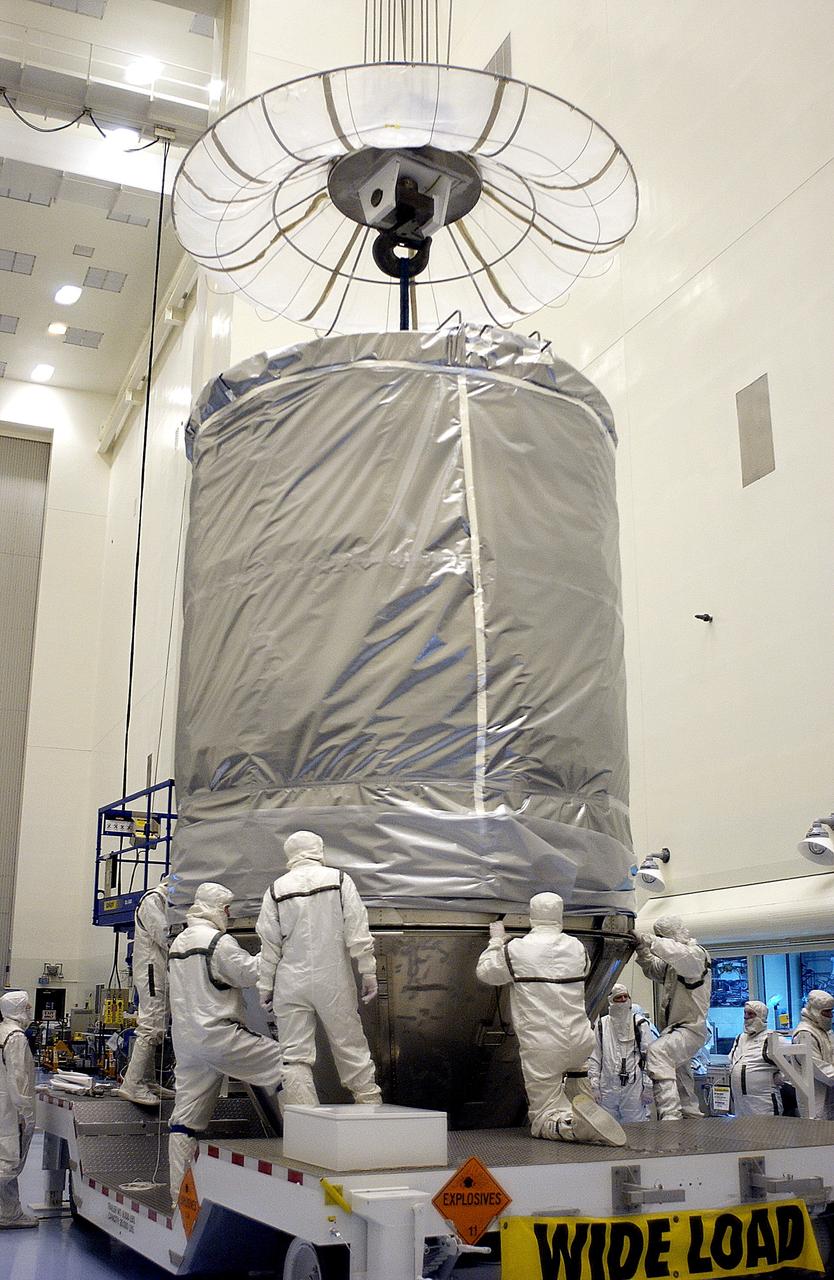
KENNEDY SPACE CENTER, FLA. - In the Payload Hazardous Servicing Facility, an overhead crane lowers the canister that will complete encapsulation of the Mars Exploration Rover 2 (MER-2), at right. After encapsulation, MER-2 will be transferred to Launch Complex 17-A, Cape Canaveral Air Force Station. MER-2 is one of NASA's twin Mars Exploration Rovers designed to study the history of water on Mars. These robotic geologists are equipped with a robotic arm, a drilling tool, three spectrometers, and four pairs of cameras that allow them to have a human-like, 3D view of the terrain. Each rover could travel as far as 100 meters in one day to act as Mars scientists' eyes and hands, exploring an environment where humans can't yet go. MER-2 is scheduled to launch no earlier than June 8 as MER-A aboard a Delta II rocket.
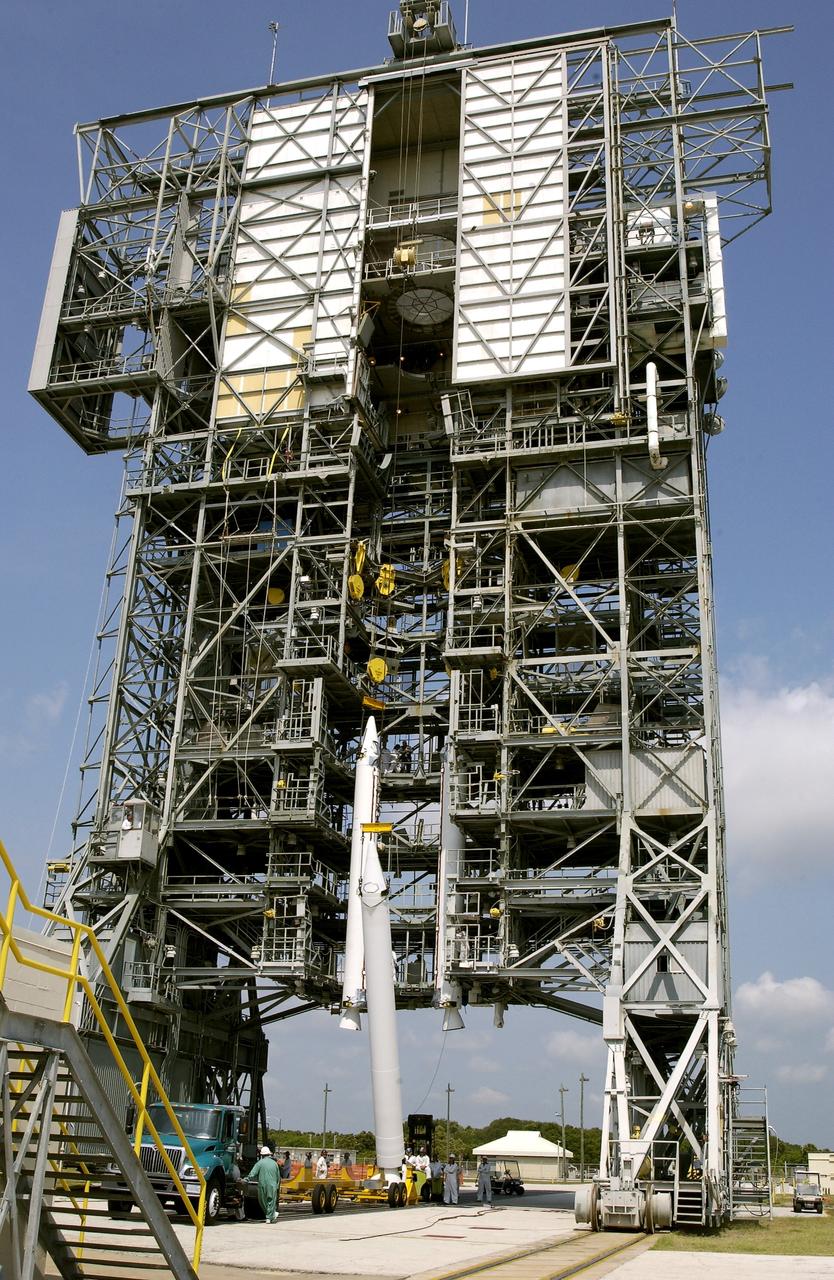
KENNEDY SPACE CENTER, FLA. - A third solid rocket booster (SRB) is lifted up the launch tower on Launch Complex 17-A, Cape Canaveral Air Force Station. They are three of nine SRBs that will be mated to the Delta rocket to launch Mars Exploration Rover 2 (MER-2). NASA’s twin Mars Exploration Rovers are designed to study the history of water on Mars. These robotic geologists are equipped with a robotic arm, a drilling tool, three spectrometers, and four pairs of cameras that allow them to have a human-like, 3D view of the terrain. Each rover could travel as far as 100 meters in one day to act as Mars scientists' eyes and hands, exploring an environment where humans can’t yet go. MER-2 is scheduled to launch June 5 as MER-A. MER-1 (MER-B) will launch June 25.
Open
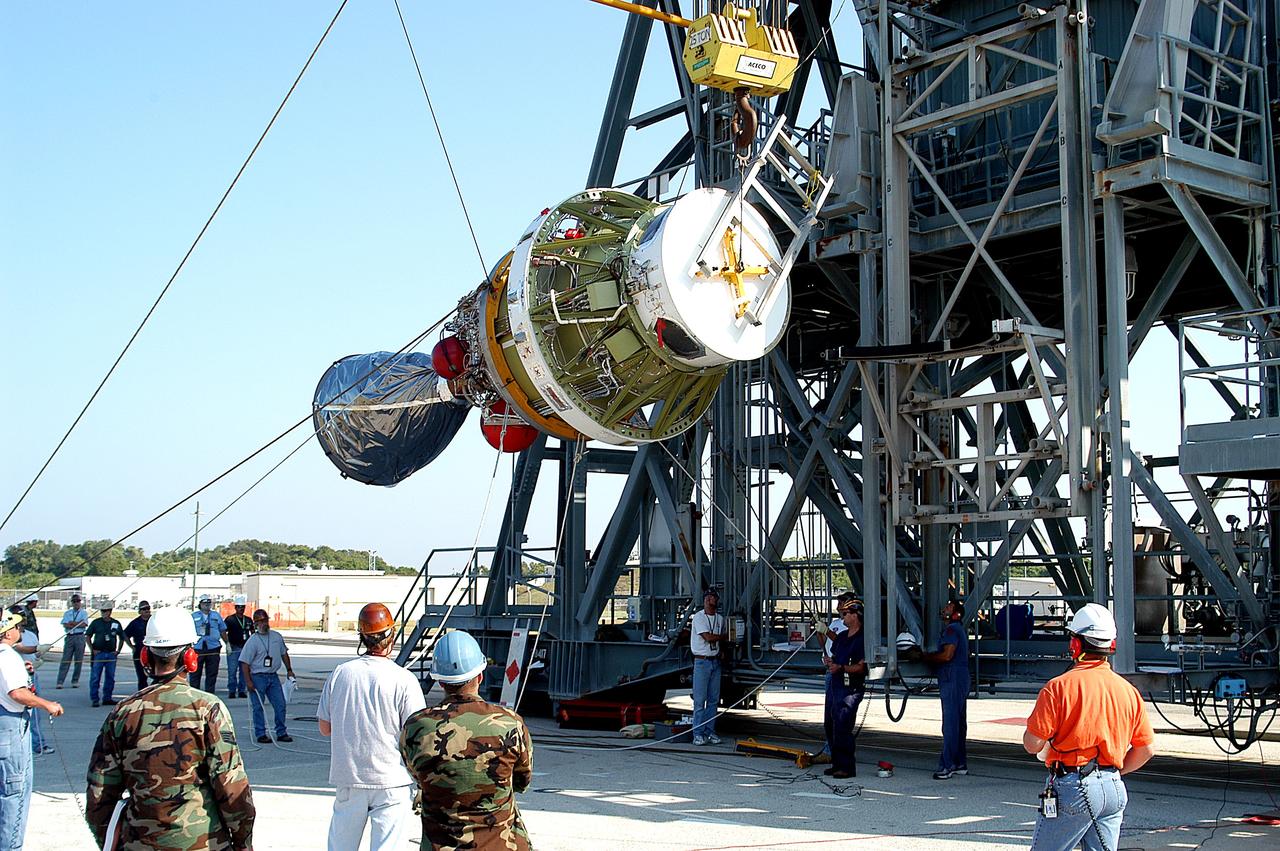
KENNEDY SPACE CENTER, FLA. - Workers begin to lift the second stage of a Delta II rocket up the launch tower on Pad 17-B, Cape Canaveral Air Force Station. It will be mated to the Delta first stage already at the pad in preparation for the launch of the Mars Exploration Rover-1 (MER-B) on June 25. NASA’s twin Mars Exploration Rovers are designed to study the history of water on Mars. These robotic geologists are equipped with a robotic arm, a drilling tool, three spectrometers, and four pairs of cameras that allow them to have a human-like, 3D view of the terrain. Each rover could travel as far as 100 meters in one day to act as Mars scientists' eyes and hands, exploring an environment where humans are not yet able to go. The launch of MER-2 (MER-A) is tentatively set for June 8.
Open
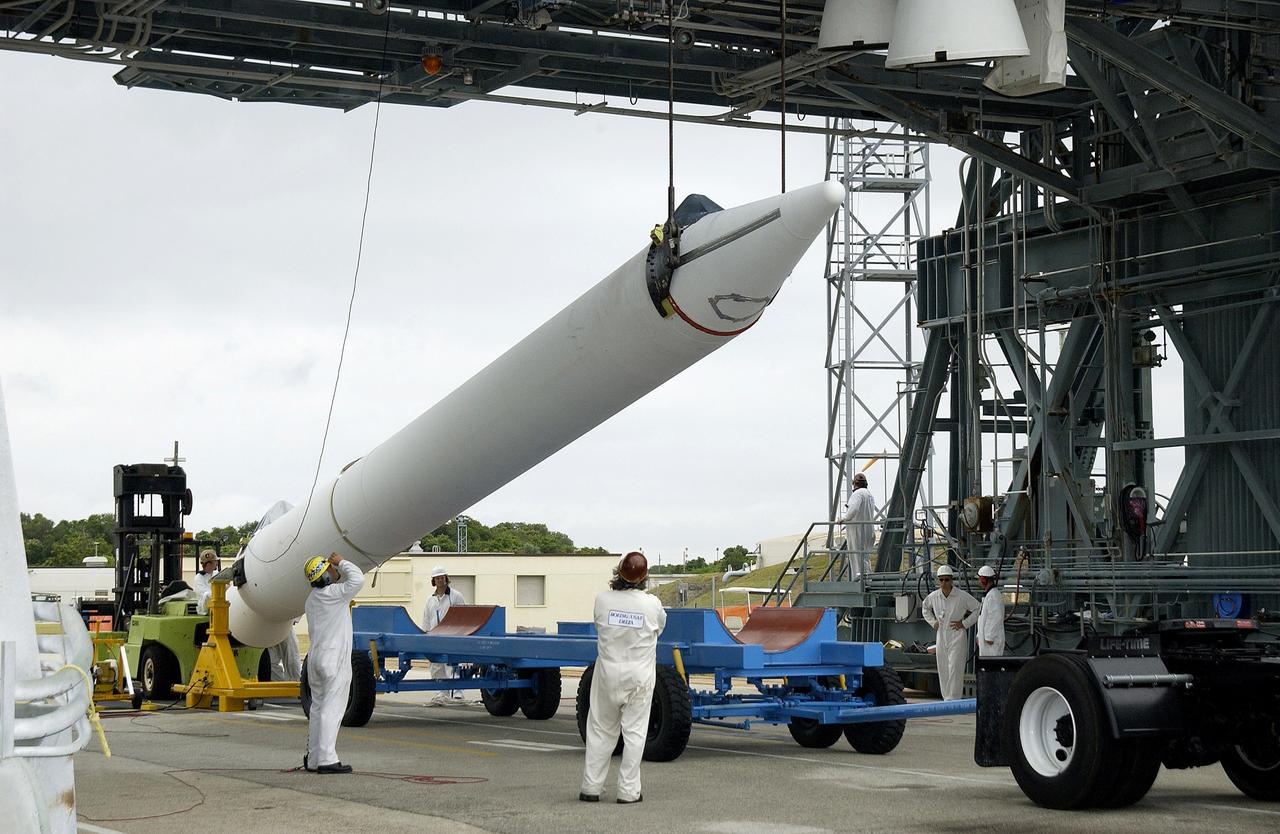
KENNEDY SPACE CENTER, FLA. - On Launch Complex 17-B, Cape Canaveral Air Force Station, a solid rocket booster is raised off its transporter to lift it to vertical. It will be mated to the Delta II rocket for the Mars Exploration Rover 1 (MER-1) launch June 25. NASA’s twin Mars Exploration Rovers are designed to study the history of water on Mars. These robotic geologists are equipped with a robotic arm, a drilling tool, three spectrometers, and four pairs of cameras that allow them to have a human-like, 3D view of the terrain. Each rover could travel as far as 100 meters in one day to act as Mars scientists' eyes and hands, exploring an environment where humans can’t yet go. MER-2 (MER-A) will launch June 5.
Open
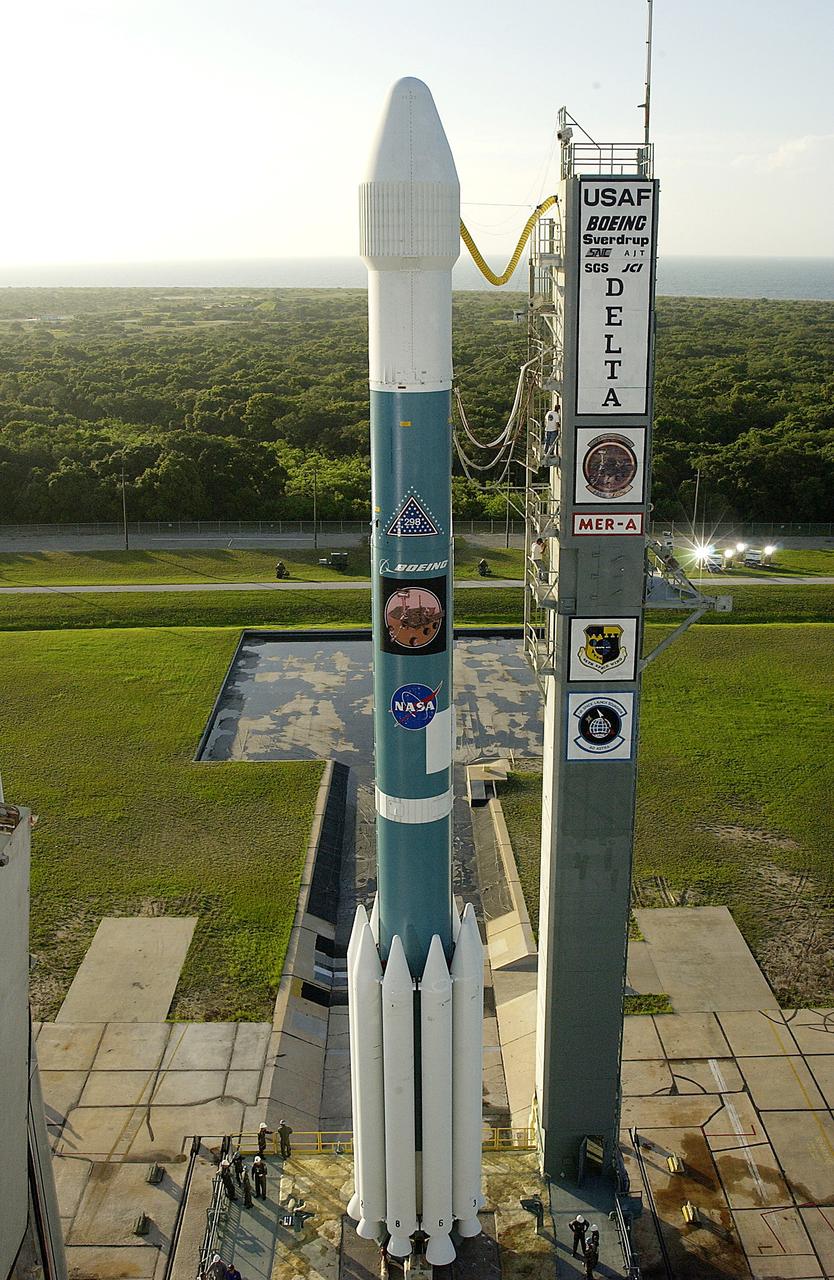
KENNEDY SPACE CENTER, FLA. - The Mobile Service Tower is rolled back at Launch Complex 17A to reveal a Delta II rocket ready to launch the Mars Exploration Rover-A mission. NASA's twin Mars Exploration Rovers are designed to study the history of water on Mars. These robotic geologists are equipped with a robotic arm, a drilling tool, three spectrometers, and four pairs of cameras that allow them to have a human-like, 3D view of the terrain. Each rover could travel as far as 100 meters in one day to act as Mars scientists' eyes and hands, exploring an environment where humans are not yet able to go. MER-A, with the rover Spirit aboard, is scheduled to launch on June 8 at 2:06 p.m. EDT, with two launch opportunities each day during a launch period that closes on June 24.
Open
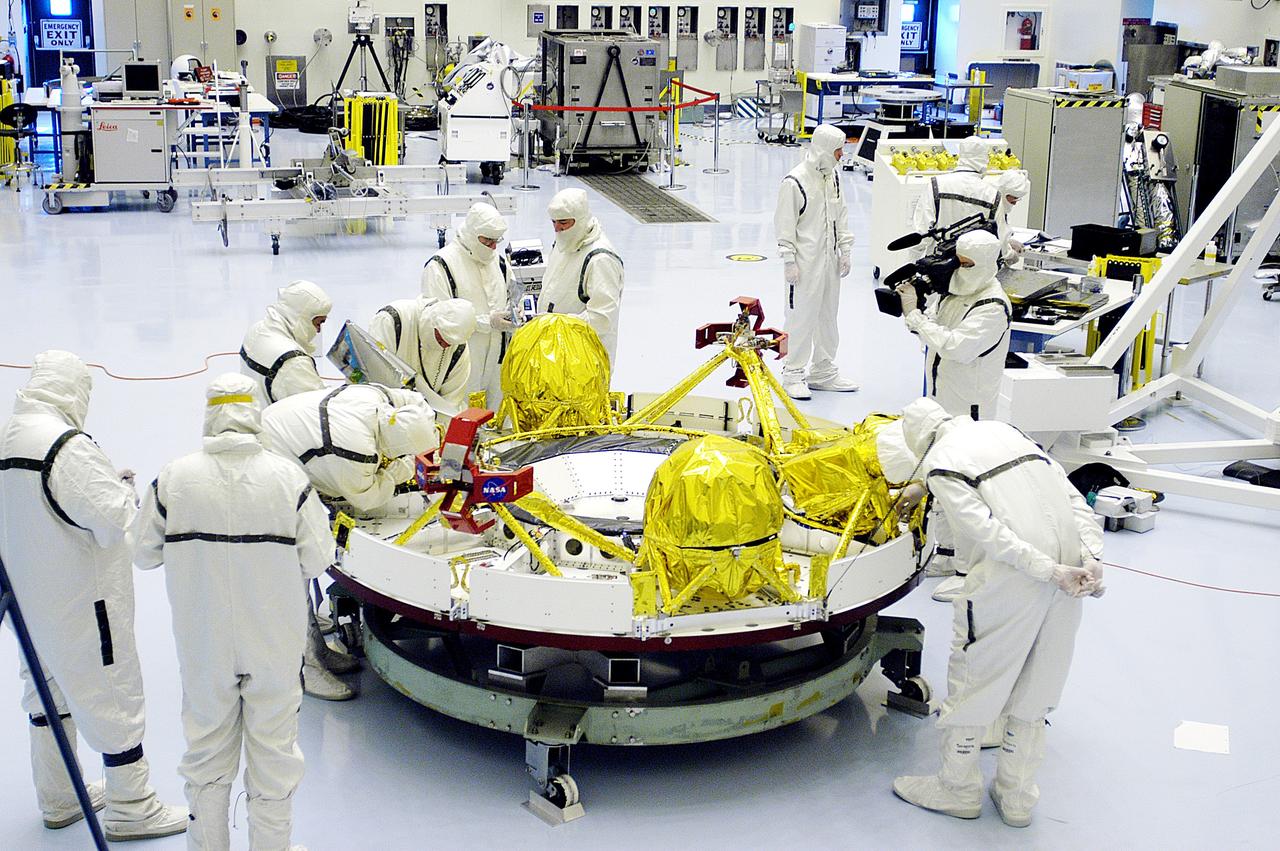
KENNEDY SPACE CENTER, FLA. - Technicians in the Payload Hazardous Servicing Facility prepare the cruise stage for Mars Exploration Rover 1 (MER-1) for integration with the aeroshell, the entry vehicle. NASA’s twin Mars Exploration Rovers are designed to study the history of water on Mars. These robotic geologists are equipped with a robotic arm, a drilling tool, three spectrometers, and four pairs of cameras that allow them to have a human-like, 3D view of the terrain. Each rover could travel as far as 100 meters in one day to act as Mars scientists' eyes and hands, exploring an environment where humans can’t yet go. The MER-1 is scheduled to launch June 25 from Launch Pad 17-A, Cape Canaveral Air Force Station.
Open
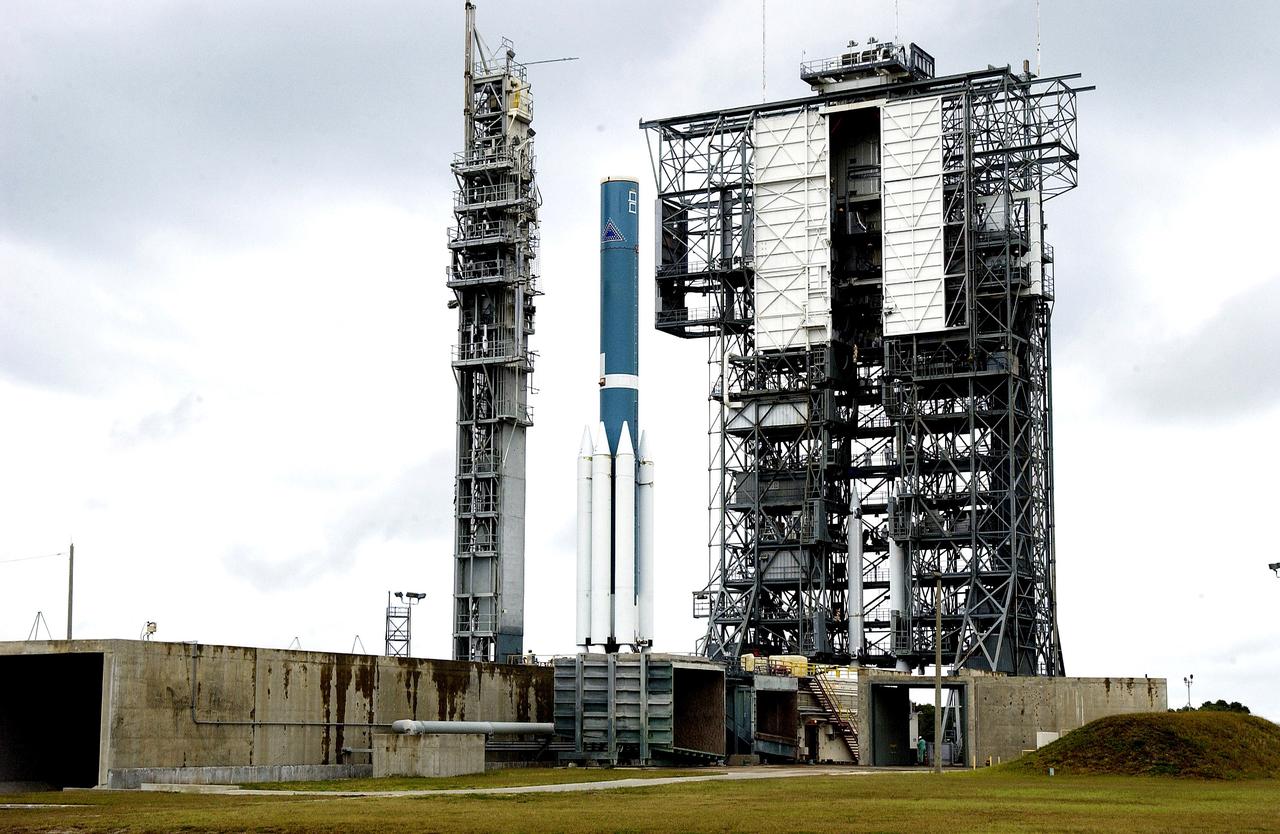
KENNEDY SPACE CENTER, FLA. - Solid rocket boosters are positioned around the base of a Delta II rocket for the Mars Exploration Rover 1 (MER-1) launch on June 25 at Launch Complex 17-B, Cape Canaveral Air Force Station. NASA’s twin Mars Exploration Rovers are designed to study the history of water on Mars. These robotic geologists are equipped with a robotic arm, a drilling tool, three spectrometers, and four pairs of cameras that allow them to have a human-like, 3D view of the terrain. Each rover could travel as far as 100 meters in one day to act as Mars scientists' eyes and hands, exploring an environment where humans can’t yet go. MER-2 (MER-A) will launch June 5.
Open
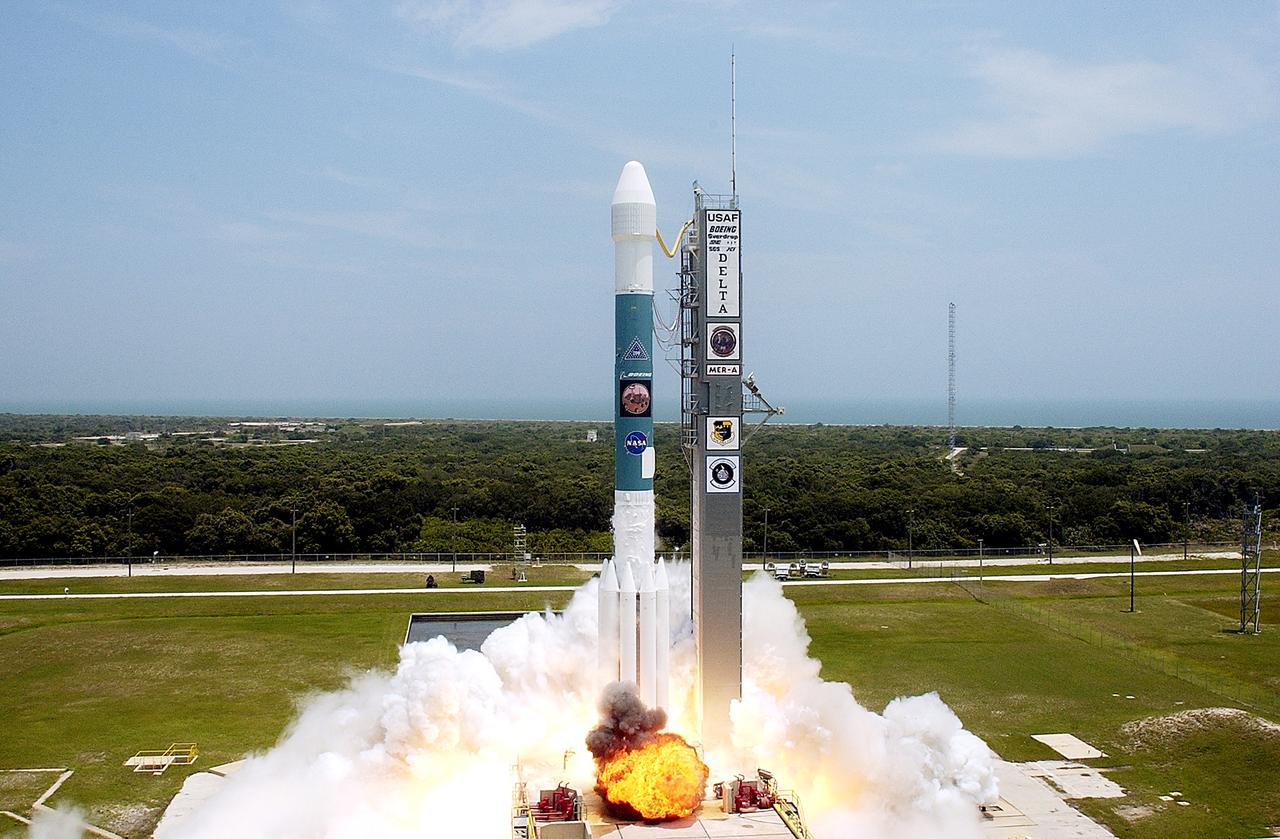
KENNEDY SPACE CENTER, FLA. - With a glimpse of the Atlantic Ocean over the horizon, the Delta II rocket with its Mars Exploration Rover (MER-A) payload leaps off the launch pad into the blue sky to begin its journey to Mars. Liftoff occurred on time at 1:58 p.m. EDT from Launch Complex 17-A, Cape Canaveral Air Force Station. MER-A, known as "Spirit," is the first of two rovers being launched to Mars. When the two rovers arrive at the red planet in 2004, they will bounce to airbag-cushioned landings at sites offering a balance of favorable conditions for safe landings and interesting science. The rovers see sharper images, can explore farther and examine rocks better than anything that has ever landed on Mars. The designated site for the MER-A mission is Gusev Crater, which appears to have been a crater lake. The second rover, MER-B, is scheduled to launch June 25.
Open
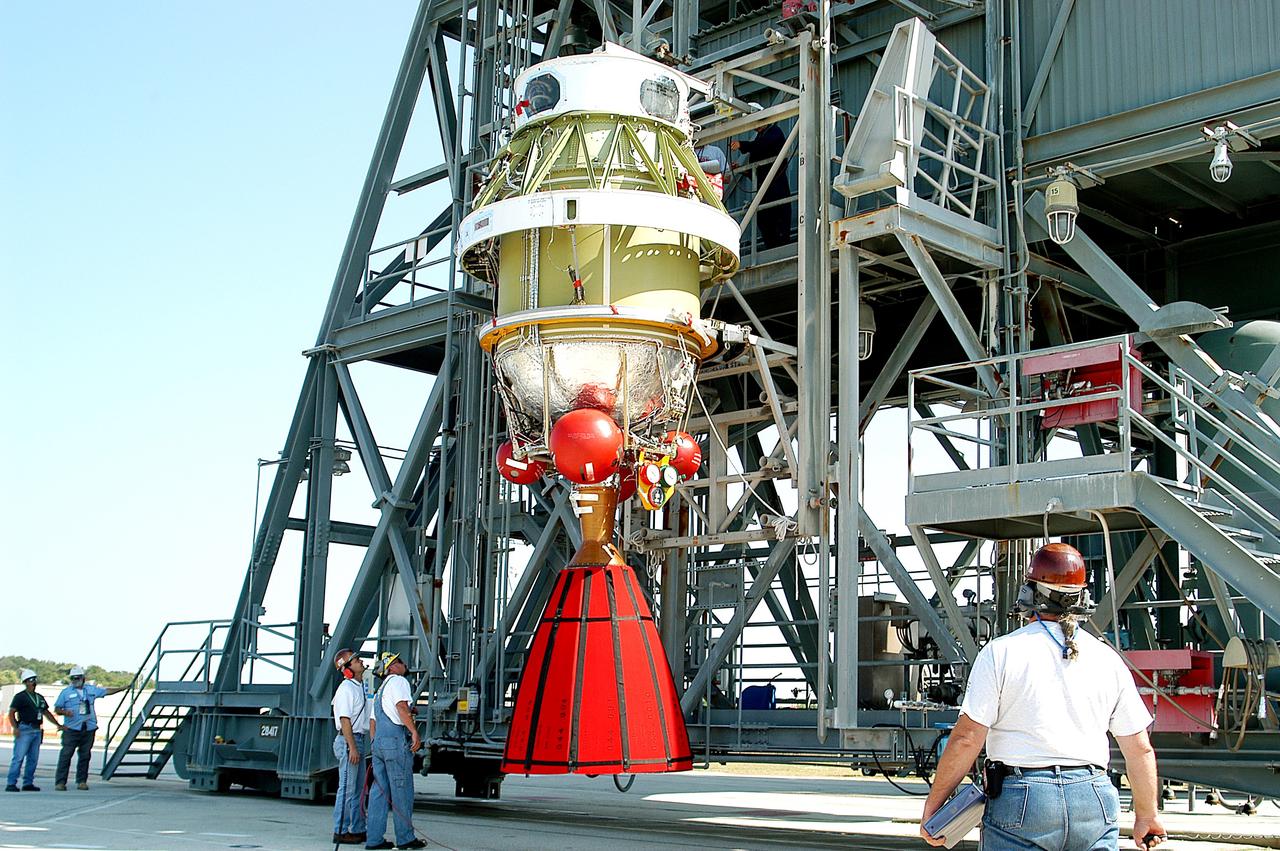
KENNEDY SPACE CENTER, FLA. - The second stage of a Delta II rocket is raised to a vertical position and prepared for its lift up the launch tower on Pad 17-B, Cape Canaveral Air Force Station. It will be mated to the Delta first stage already at the pad in preparation for the launch of the Mars Exploration Rover-1 (MER-B) on June 25. NASA’s twin Mars Exploration Rovers are designed to study the history of water on Mars. These robotic geologists are equipped with a robotic arm, a drilling tool, three spectrometers, and four pairs of cameras that allow them to have a human-like, 3D view of the terrain. Each rover could travel as far as 100 meters in one day to act as Mars scientists' eyes and hands, exploring an environment where humans are not yet able to go. The launch of MER-2 (MER-A) is tentatively set for June 8.
Open
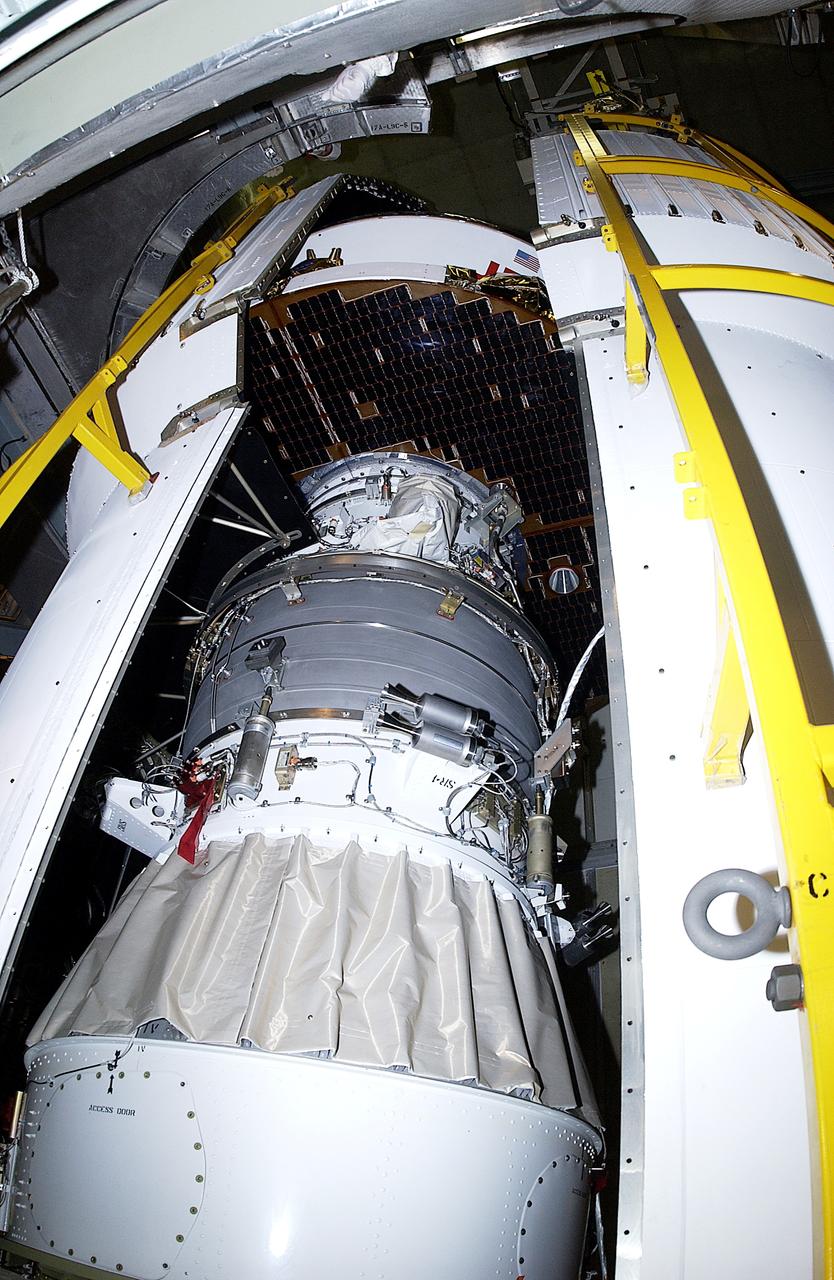
KENNEDY SPACE CENTER, FLA. - The second half of the fairing closes in around the Mars Exploration Rover 2 (MER-2) on Launch Complex 17-A, Cape Canaveral Air Force Station. MER-2 is one of NASA's twin Mars Exploration Rovers designed to study the history of water on Mars. These robotic geologists are equipped with a robotic arm, a drilling tool, three spectrometers, and four pairs of cameras that allow them to have a human-like, 3D view of the terrain. Each rover could travel as far as 100 meters in one day to act as Mars scientists' eyes and hands, exploring an environment where humans can't yet go. MER-2 is scheduled to launch no earlier than June 8 as MER-A, with two launch opportunities each day during the launch period that closes on June 19.
Open
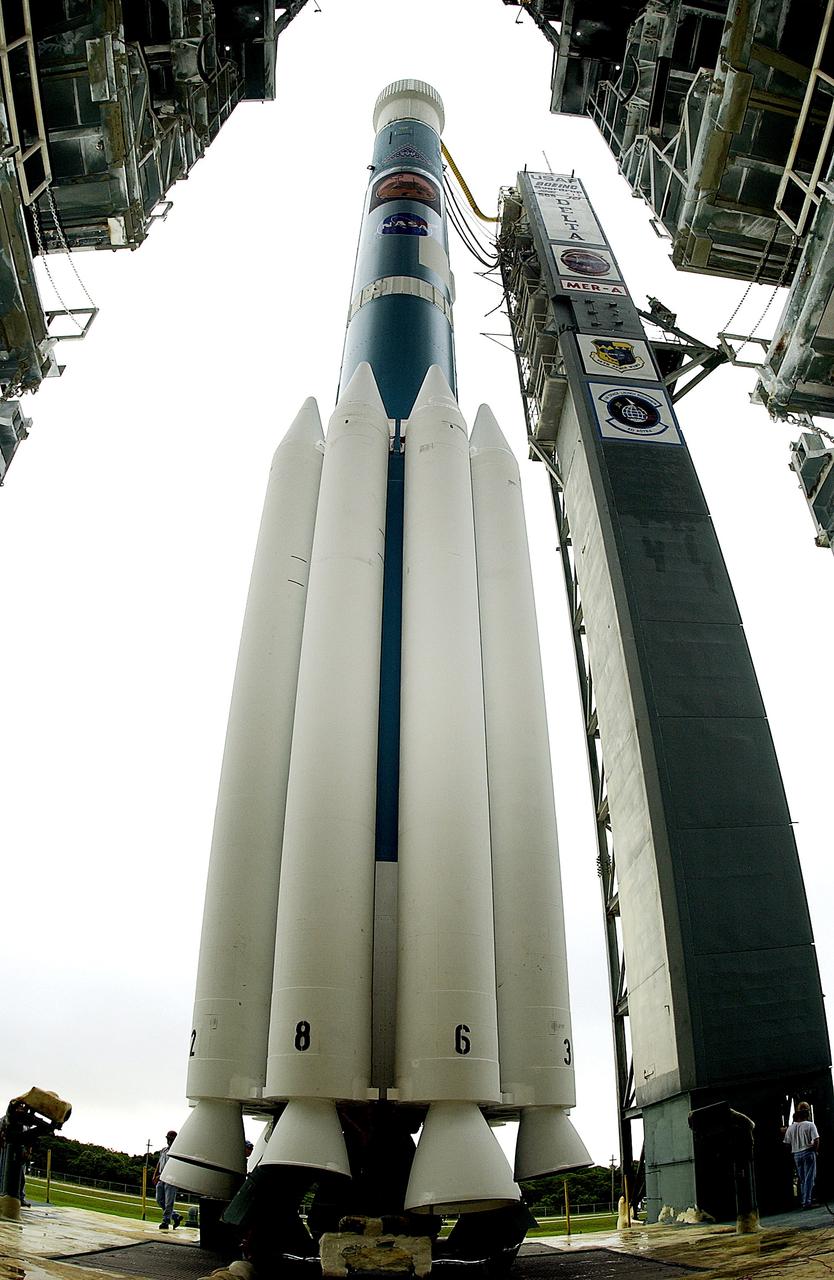
KENNEDY SPACE CENTER, FLA. - On Launch Complex 17-A, Cape Canaveral Air Force Station, the Boeing Delta II rocket and its Mars Exploration Rover (MER-A) payload are viewed as the launch tower overhead rolls back. This will be the third launch attempt in as many days after weather concerns postponed the launches June 8 and June 9. MER-A is the first of two rovers being launched to Mars. When the two rovers arrive at Mars in 2004, they will bounce to airbag-cushioned landings at sites offering a balance of favorable conditions for safe landings and interesting science. The rovers see sharper images, can explore farther and examine rocks better than anything that has ever landed on Mars. The designated site for MER-A mission is Gusev Crater, which appears to have been a crater lake. The second rover, MER-B, is scheduled to launch June 25.
Open
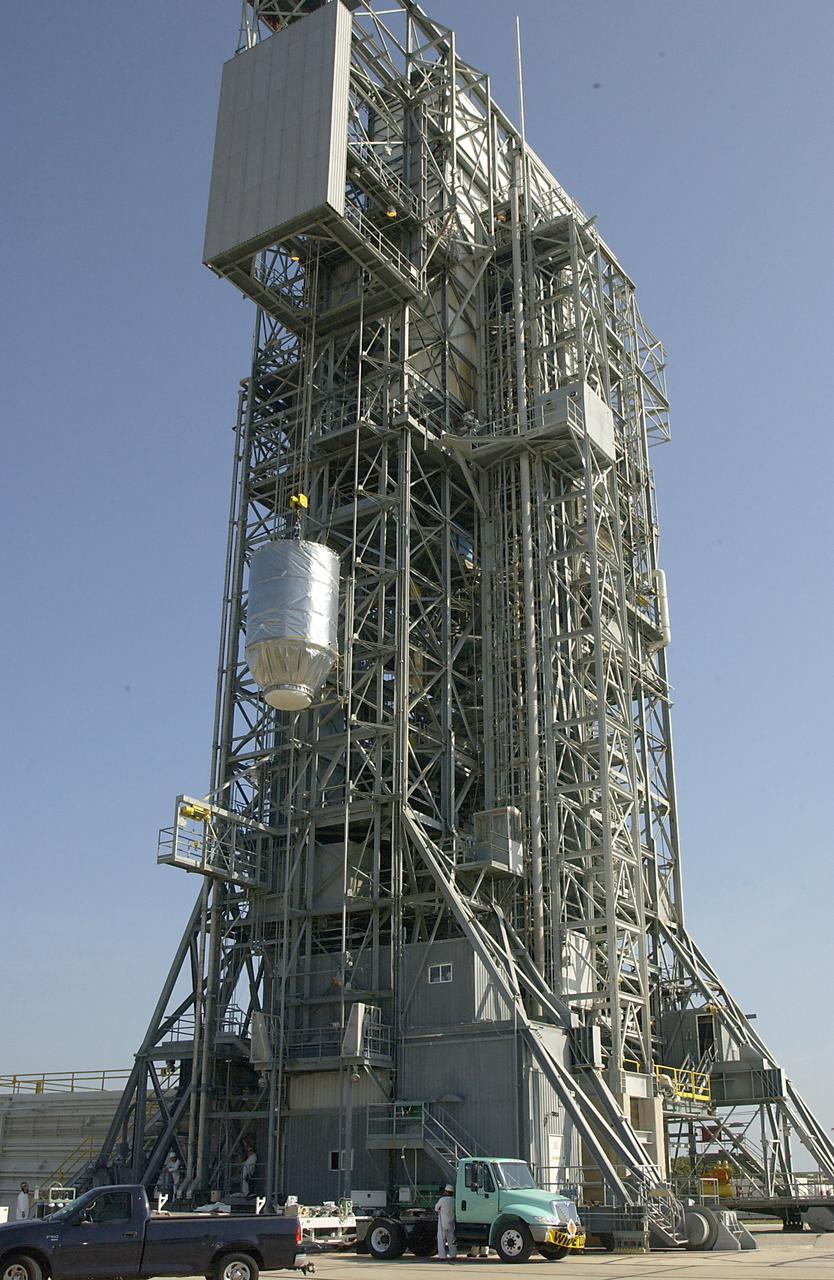
KENNEDY SPACE CENTER, FLA. - On Launch Pad 17-A, Cape Canaveral Air Force Station, the Mars Exploration Rover 2 (MER-2), inside the transport canister, is lifted up the launch tower where it will be mated to the Delta II rocket for launch. MER-2 is one of NASA's twin Mars Exploration Rovers designed to study the history of water on Mars. These robotic geologists are equipped with a robotic arm, a drilling tool, three spectrometers, and four pairs of cameras that allow them to have a human-like, 3D view of the terrain. Each rover could travel as far as 100 meters in one day to act as Mars scientists' eyes and hands, exploring an environment where humans can't yet go. MER-2 is scheduled to launch no earlier than June 8 as MER-A.
Open
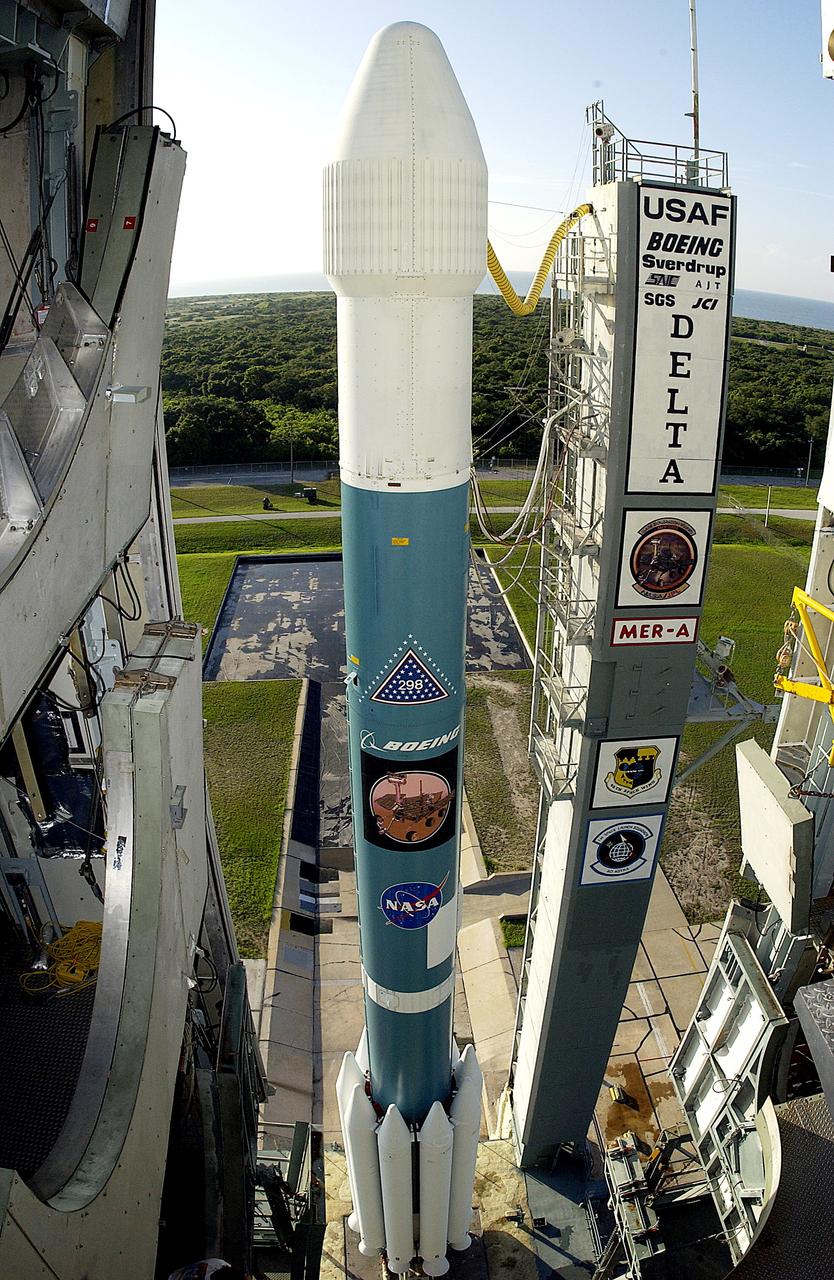
KENNEDY SPACE CENTER, FLA. - The launch tower on Launch Complex 17-A, Cape Canaveral Air Force Station, clears the Boeing Delta II rocket and its Mars Exploration Rover (MER-A) payload in preparation for a second attempt at launch. The first attempt on June 8, 2003, was scrubbed due to bad weather in the vicinity. MER-A is the first of two rovers being launched to Mars. When the two rovers arrive at Mars in 2004, they will bounce to airbag-cushioned landings at sites offering a balance of favorable conditions for safe landings and interesting science. The rovers see sharper images, can explore farther and examine rocks better than anything that has ever landed on Mars. The designated site for MER-A mission is Gusev Crater, which appears to have been a crater lake. The second rover, MER-B, is scheduled to launch June 25.
Open
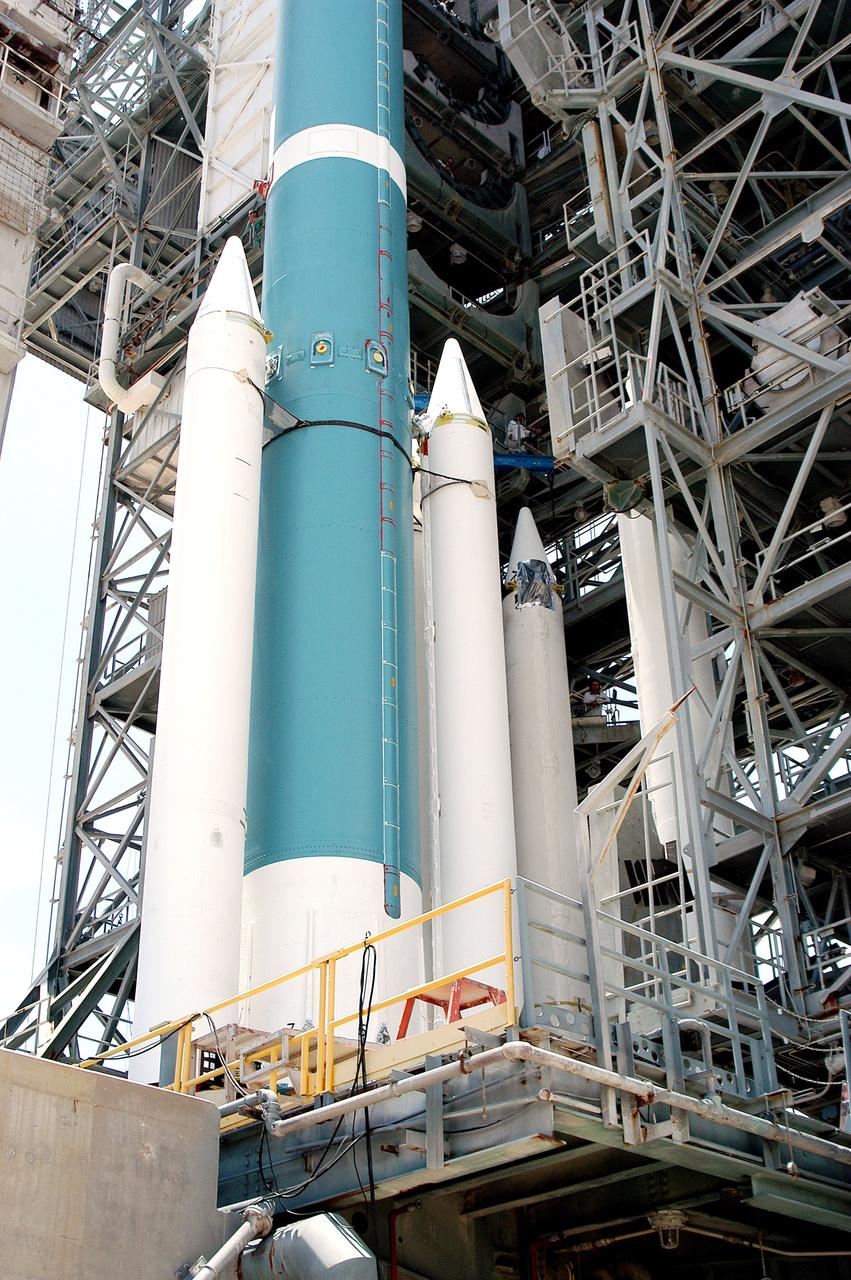
KENNEDY SPACE CENTER, FLA. - On the launch tower of Launch Complex 17-B, Cape Canaveral Air Force Station, solid rocket boosters are mated to the Delta II rocket for the Mars Exploration Rover 1 (MER-1) launch June 25. NASA’s twin Mars Exploration Rovers are designed to study the history of water on Mars. These robotic geologists are equipped with a robotic arm, a drilling tool, three spectrometers, and four pairs of cameras that allow them to have a human-like, 3D view of the terrain. Each rover could travel as far as 100 meters in one day to act as Mars scientists' eyes and hands, exploring an environment where humans can’t yet go. MER-2 (MER-A) will launch June 5.
Open
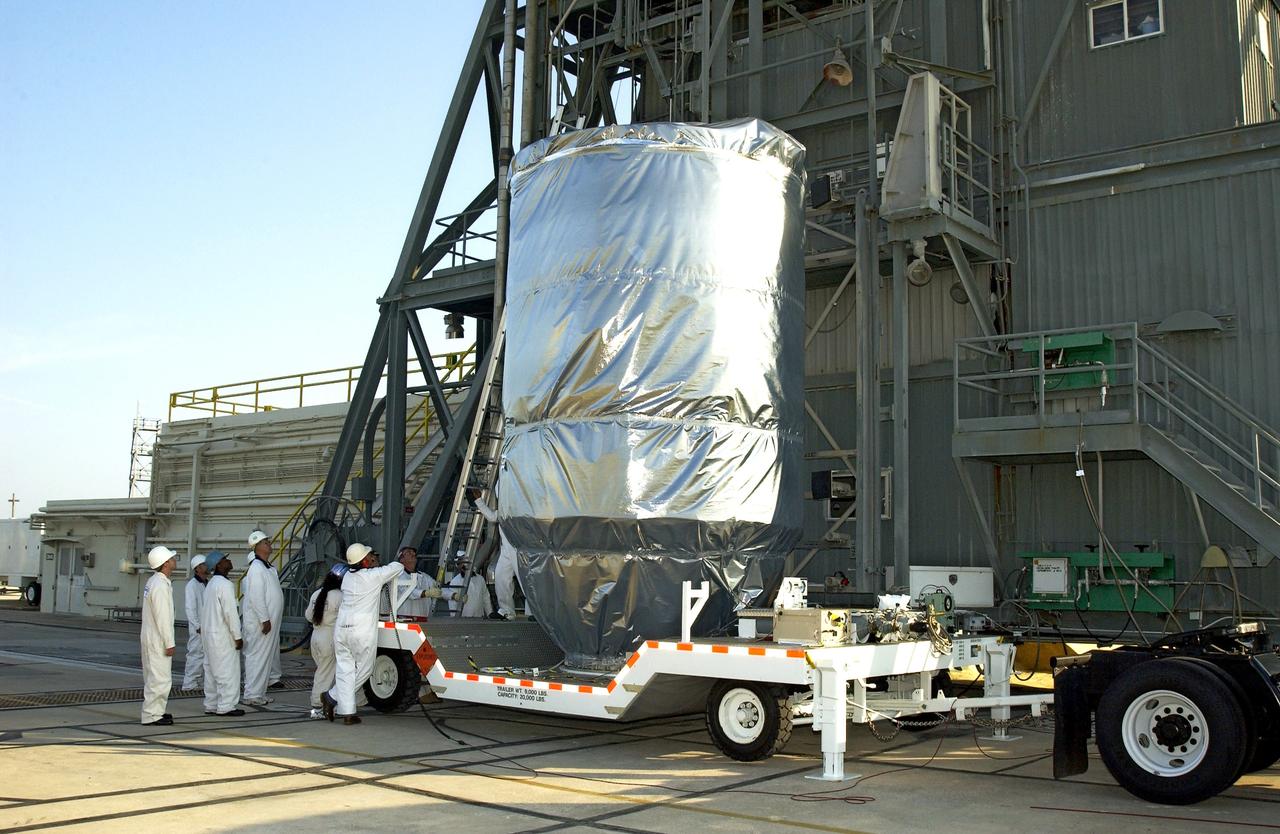
KENNEDY SPACE CENTER, FLA. - The Mars Exploration Rover 2 (MER-2), inside the transport canister, will be lifted up the launch tower on Launch Pad 17-A, Cape Canaveral Air Force Station, where it will be mated to the Delta II rocket for launch. MER-2 is one of NASA's twin Mars Exploration Rovers designed to study the history of water on Mars. These robotic geologists are equipped with a robotic arm, a drilling tool, three spectrometers, and four pairs of cameras that allow them to have a human-like, 3D view of the terrain. Each rover could travel as far as 100 meters in one day to act as Mars scientists' eyes and hands, exploring an environment where humans can't yet go. MER-2 is scheduled to launch no earlier than June 8 as MER-A.
Open
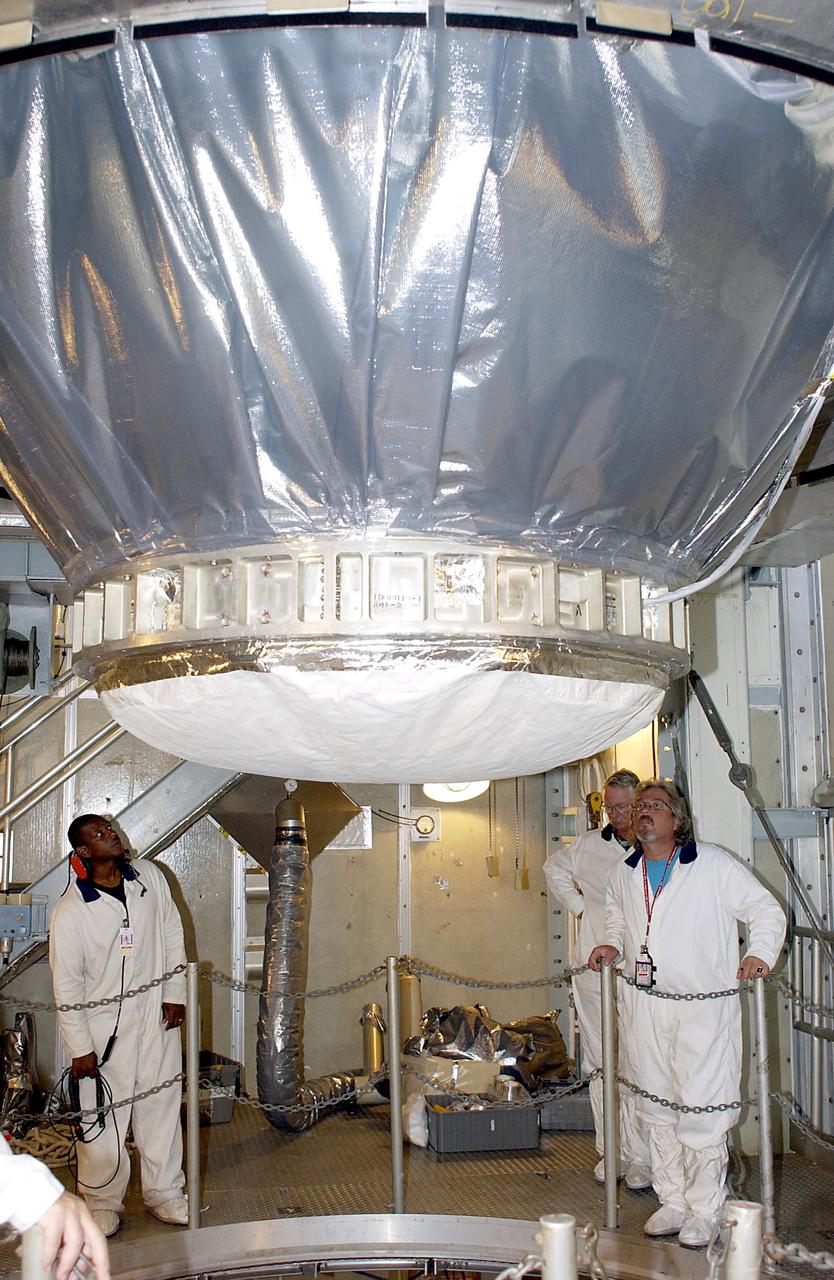
KENNEDY SPACE CENTER, FLA. - On Launch Pad 17-A, Cape Canaveral Air Force Station, workers watch as the Mars Exploration Rover 2 (MER-2), inside the transport canister, is lowered toward the Delta II rocket for mating. MER-2 is one of NASA's twin Mars Exploration Rovers designed to study the history of water on Mars. These robotic geologists are equipped with a robotic arm, a drilling tool, three spectrometers, and four pairs of cameras that allow them to have a human-like, 3D view of the terrain. Each rover could travel as far as 100 meters in one day to act as Mars scientists' eyes and hands, exploring an environment where humans can't yet go. MER-2 is scheduled to launch no earlier than June 8 as MER-A.
Open
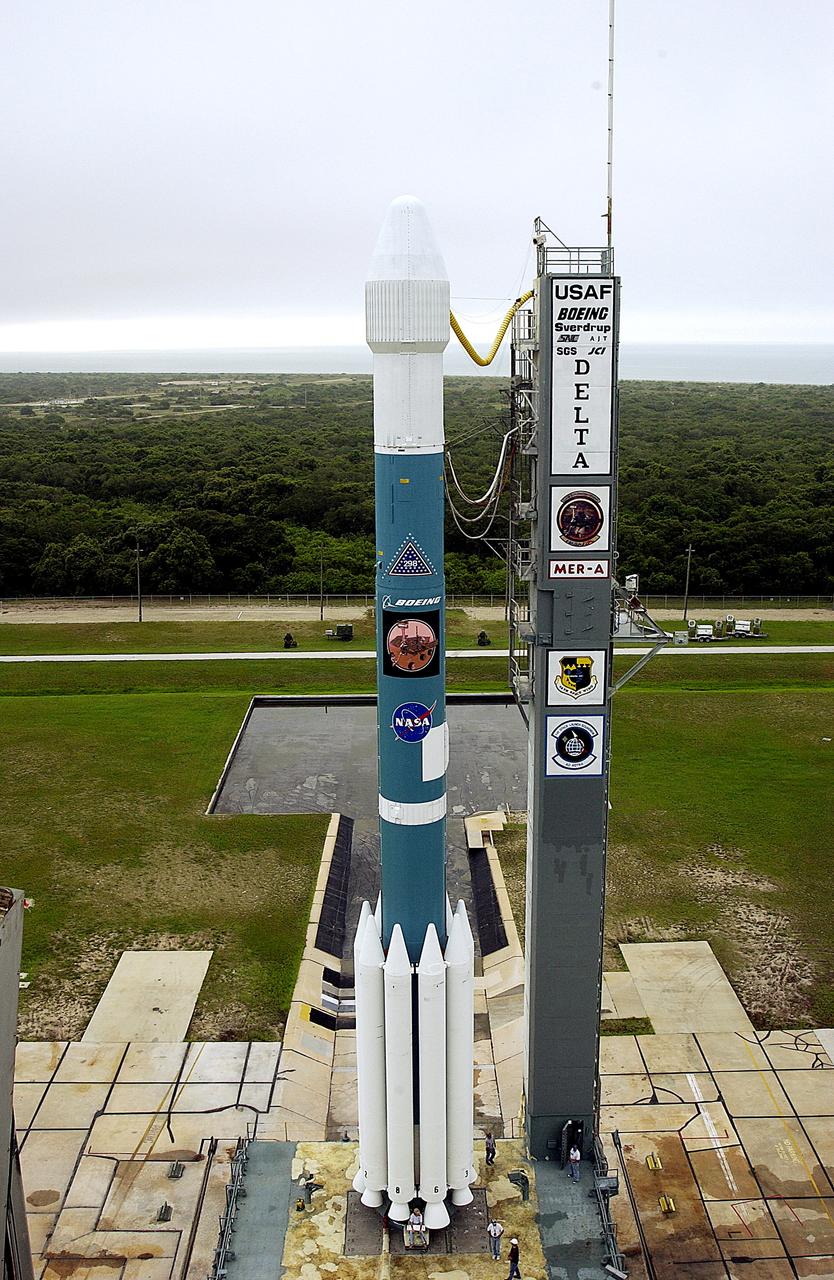
KENNEDY SPACE CENTER, FLA. - On Launch Complex 17-A, Cape Canaveral Air Force Station, the Boeing Delta II rocket and its Mars Exploration Rover (MER-A) payload are free of the tower and ready for launch. This will be the third launch attempt in as many days after weather concerns postponed the launches June 8 and June 9. MER-A is the first of two rovers being launched to Mars. When the two rovers arrive at Mars in 2004, they will bounce to airbag-cushioned landings at sites offering a balance of favorable conditions for safe landings and interesting science. The rovers see sharper images, can explore farther and examine rocks better than anything that has ever landed on Mars. The designated site for MER-A mission is Gusev Crater, which appears to have been a crater lake. The second rover, MER-B, is scheduled to launch June 25.
Open
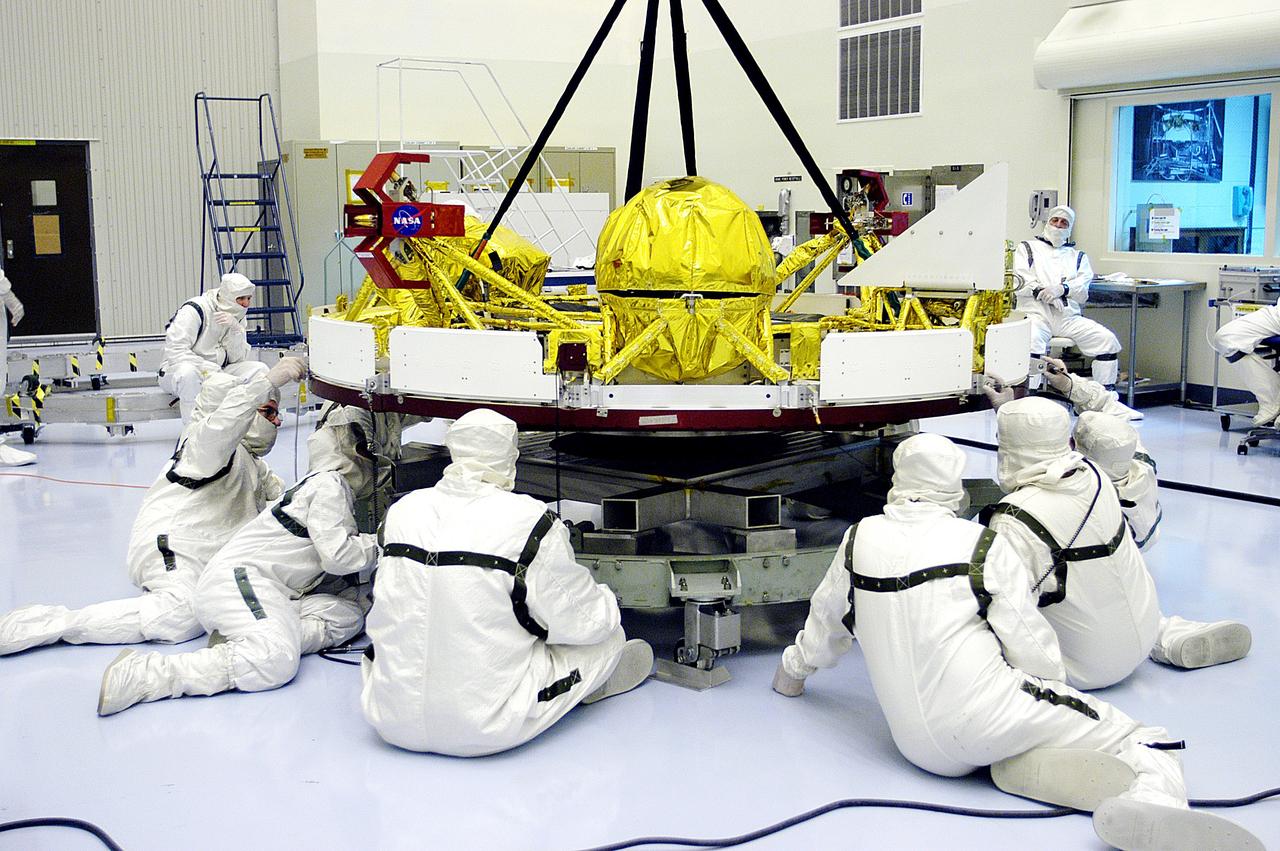
KENNEDY SPACE CENTER, FLA. - In the Payload Hazardous Servicing Facility, workers check the cruise stage of Mars Exploration Rover 1 (MER-1) being lifted off a stand. The cruise stage will be integrated with the aeroshell, the entry vehicle. NASA’s twin Mars Exploration Rovers are designed to study the history of water on Mars. These robotic geologists are equipped with a robotic arm, a drilling tool, three spectrometers, and four pairs of cameras that allow them to have a human-like, 3D view of the terrain. Each rover could travel as far as 100 meters in one day to act as Mars scientists' eyes and hands, exploring an environment where humans can’t yet go. The MER-1 is scheduled to launch June 25 from Launch Pad 17-A, Cape Canaveral Air Force Station.
Open
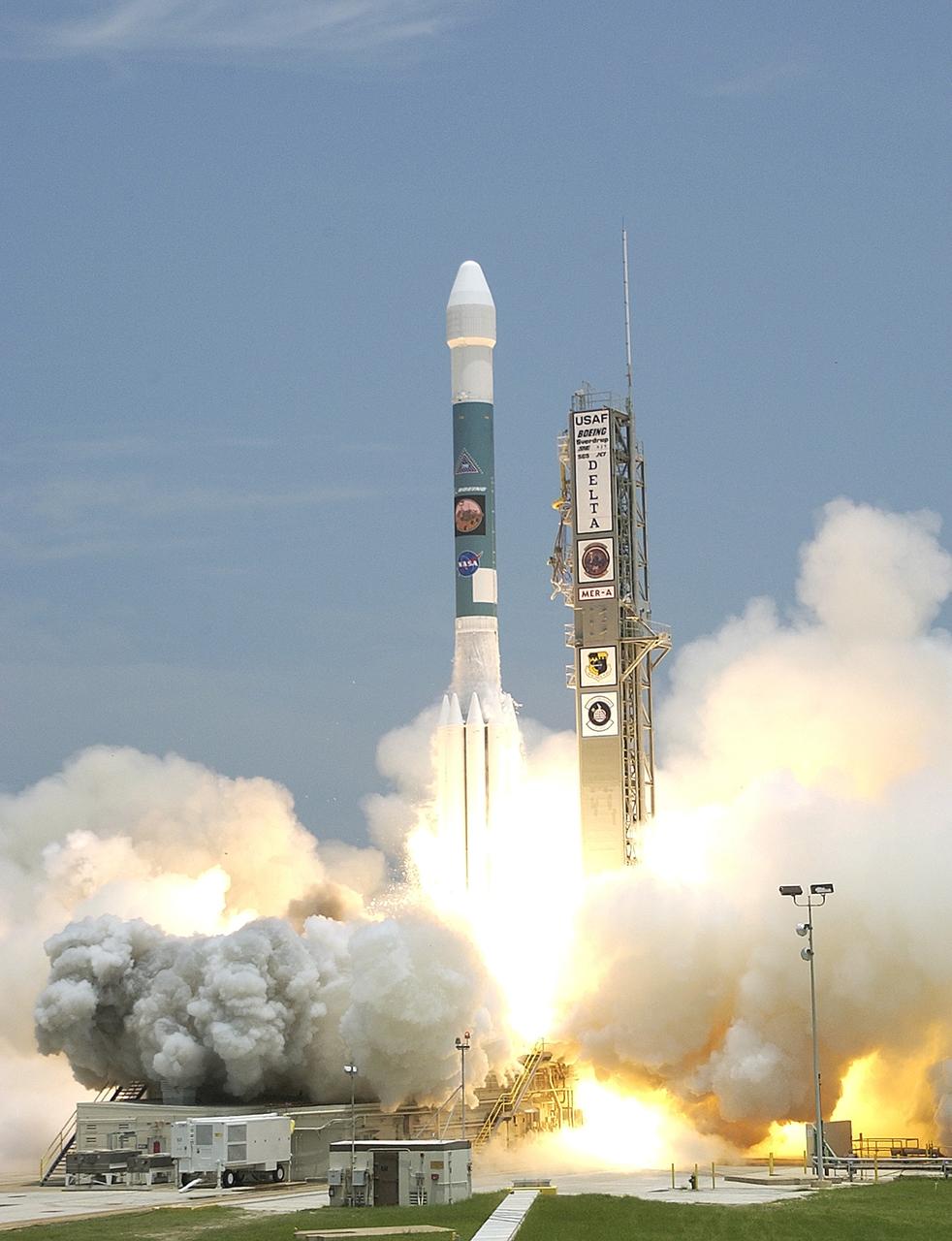
KENNEDY SPACE CENTER, FLA. - The Delta II rocket with its Mars Exploration Rover (MER-A) payload leaps off the launch pad into the blue sky to begin its journey to Mars. Liftoff occurred on time at 1:58 p.m. EDT from Launch Complex 17-A, Cape Canaveral Air Force Station. MER-A, known as "Spirit," is the first of two rovers being launched to Mars. When the two rovers arrive at the red planet in 2004, they will bounce to airbag-cushioned landings at sites offering a balance of favorable conditions for safe landings and interesting science. The rovers see sharper images, can explore farther and examine rocks better than anything that has ever landed on Mars. The designated site for the MER-A mission is Gusev Crater, which appears to have been a crater lake. The second rover, MER-B, is scheduled to launch June 25.
Open
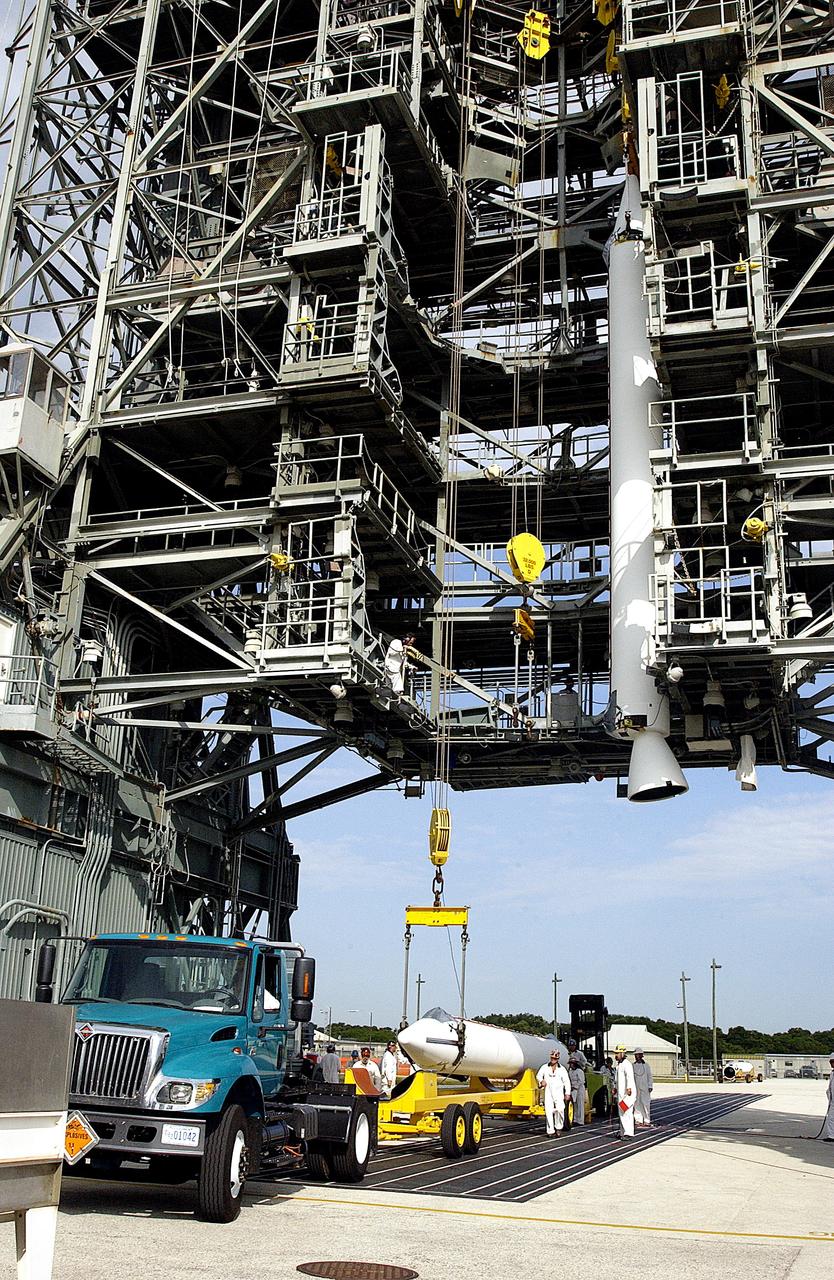
KENNEDY SPACE CENTER, FLA. - While one solid rocket booster (SRB) is suspended in the launch tower on Launch Complex 17-A, Cape Canaveral Air Force Station, another is raised from its transporter for a similar lift. They are two of nine SRBs that will be mated to the Delta rocket to launch Mars Exploration Rover 2. NASA’s twin Mars Exploration Rovers are designed to study the history of water on Mars. These robotic geologists are equipped with a robotic arm, a drilling tool, three spectrometers, and four pairs of cameras that allow them to have a human-like, 3D view of the terrain. Each rover could travel as far as 100 meters in one day to act as Mars scientists' eyes and hands, exploring an environment where humans can’t yet go. MER-2 is scheduled to launch June 5 as MER-A. MER-1 (MER-B) will launch June 25.
Open
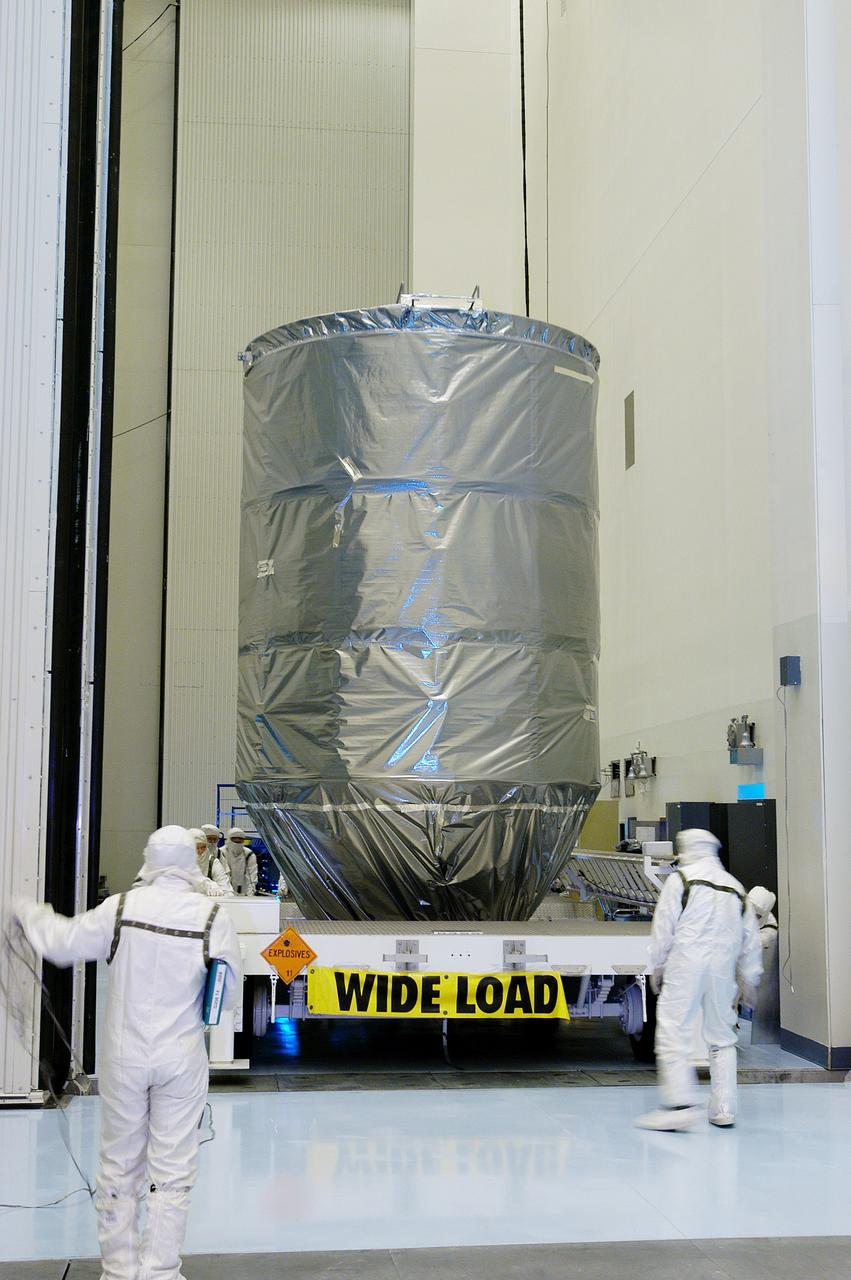
KENNEDY SPACE CENTER, FLA. - The Delta II rocket’s third stage arrives at the Payload Hazardous Servicing Facility. It will be mated with the Mars Exploration Rover 2 (MER-2) and then installed into the transportation canister for transfer to the launch pad. NASA's twin Mars Exploration Rovers are designed to study the history of water on Mars. These robotic geologists are equipped with a robotic arm, a drilling tool, three spectrometers, and four pairs of cameras that allow them to have a human-like, 3D view of the terrain. Each rover could travel as far as 100 meters in one day to act as Mars scientists' eyes and hands, exploring an environment where humans can't yet go. MER-2 is scheduled to launch June 5 as MER-A aboard a Delta II rocket from Cape Canaveral Air Force Station.
Open
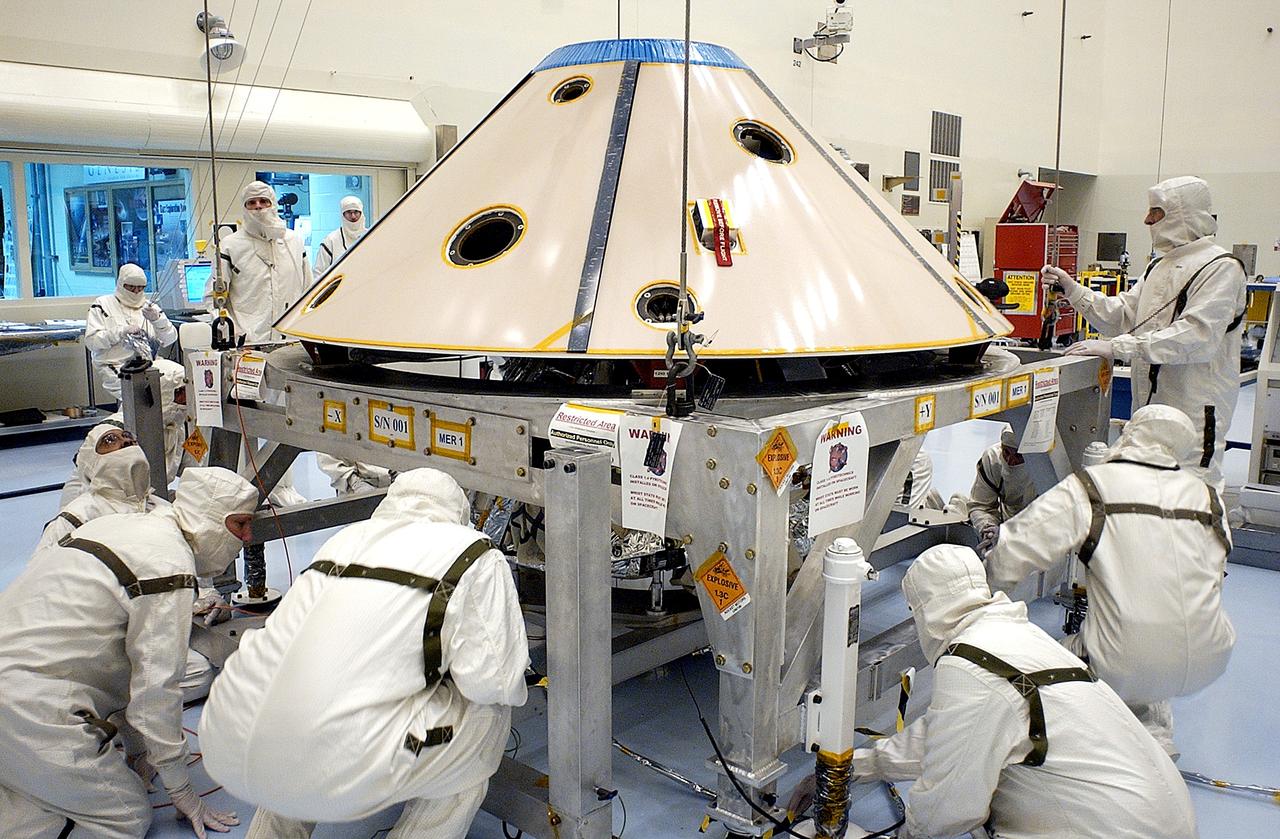
KENNEDY SPACE CENTER, FLA. - Workers in the Payload Hazardous Servicing Facility check the placement of the backshell over the Mars Exploration Rover 1 (MER-1). The backshell is a protective cover for the rover. NASA's twin Mars Exploration Rovers are designed to study the history of water on Mars. These robotic geologists are equipped with a robotic arm, a drilling tool, three spectrometers, and four pairs of cameras that allow them to have a human-like, 3D view of the terrain. Each rover could travel as far as 100 meters in one day to act as Mars scientists' eyes and hands, exploring an environment where humans can't yet go. MER-1 is scheduled to launch June 25 as MER-B aboard a Delta II rocket from Cape Canaveral Air Force Station.
Open
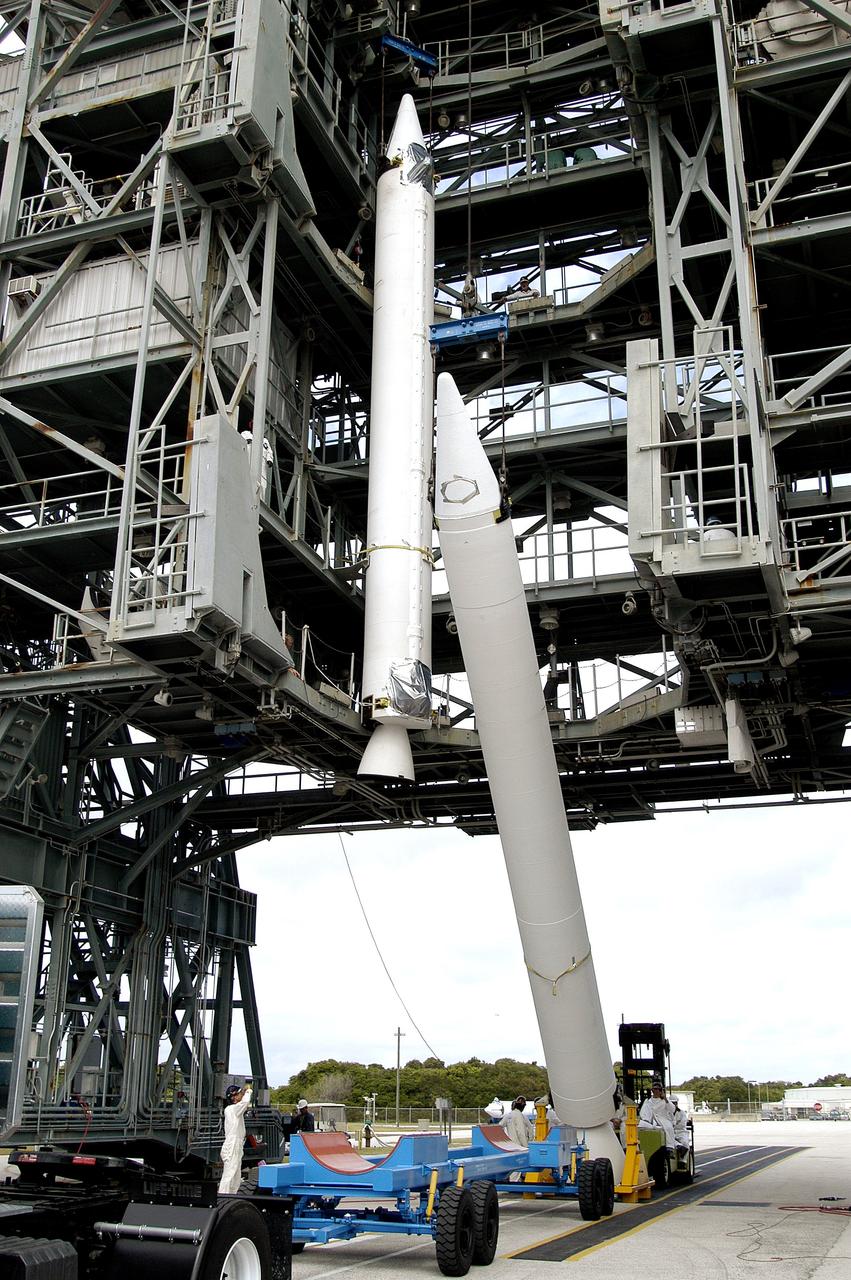
KENNEDY SPACE CENTER, FLA. - Another solid rocket booster is raised to vertical on Launch Complex 17-B, Cape Canaveral Air Force Station. It is the second of nine SRBs that will be mated to the Delta II rocket for the Mars Exploration Rover 1 (MER-1) launch June 25. NASA’s twin Mars Exploration Rovers are designed to study the history of water on Mars. These robotic geologists are equipped with a robotic arm, a drilling tool, three spectrometers, and four pairs of cameras that allow them to have a human-like, 3D view of the terrain. Each rover could travel as far as 100 meters in one day to act as Mars scientists' eyes and hands, exploring an environment where humans can’t yet go. MER-2 (MER-A) will launch June 5.
Open
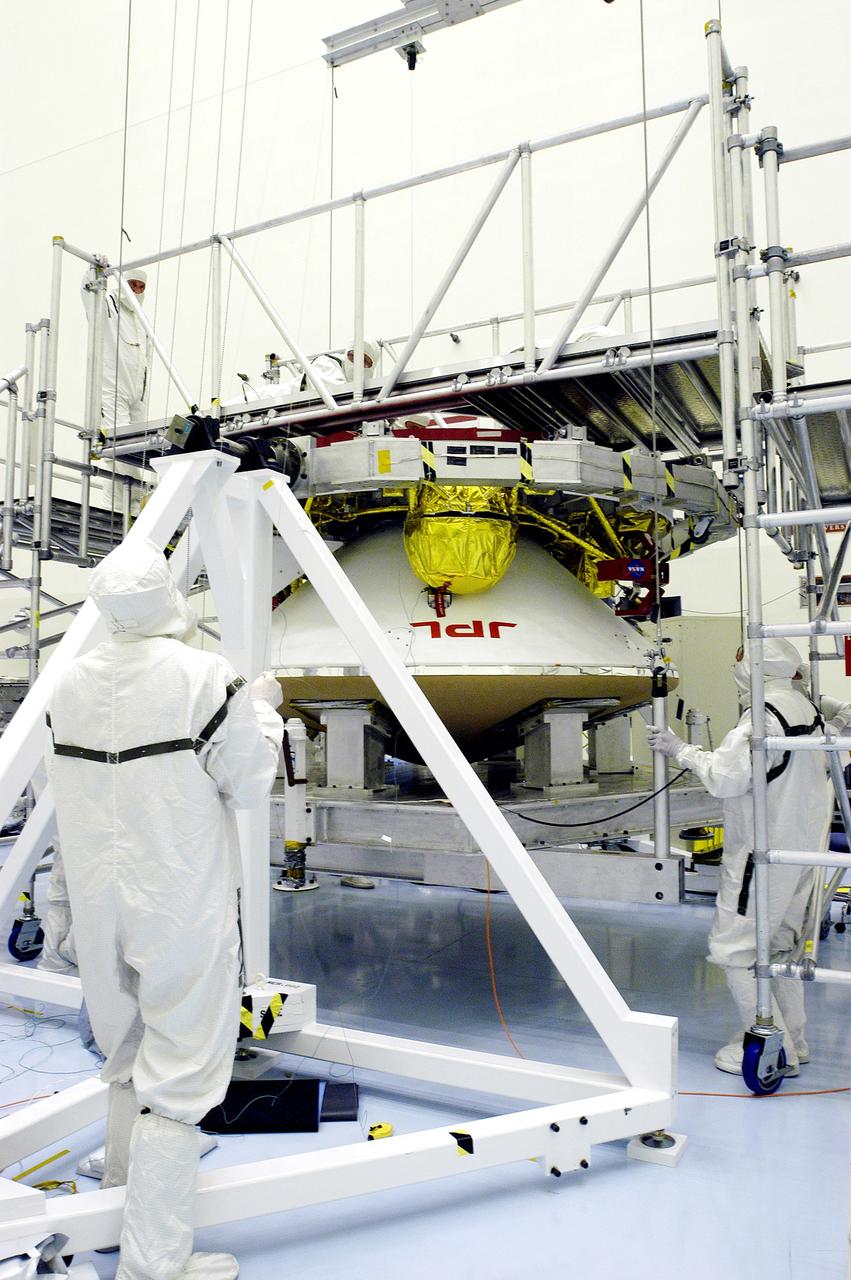
KENNEDY SPACE CENTER, FLA. - Workers in the Payload Hazardous Servicing Facility check the mating of the Mars Exploration Rover 1 (MER-1) cruise stage to the lander below it. NASA's twin Mars Exploration Rovers are designed to study the history of water on Mars. These robotic geologists are equipped with a robotic arm, a drilling tool, three spectrometers, and four pairs of cameras that allow them to have a human-like, 3D view of the terrain. Each rover could travel as far as 100 meters in one day to act as Mars scientists' eyes and hands, exploring an environment where humans can't yet go. MER-1 is scheduled to launch June 25 as MER-B aboard a Delta II rocket from Cape Canaveral Air Force Station.
Open
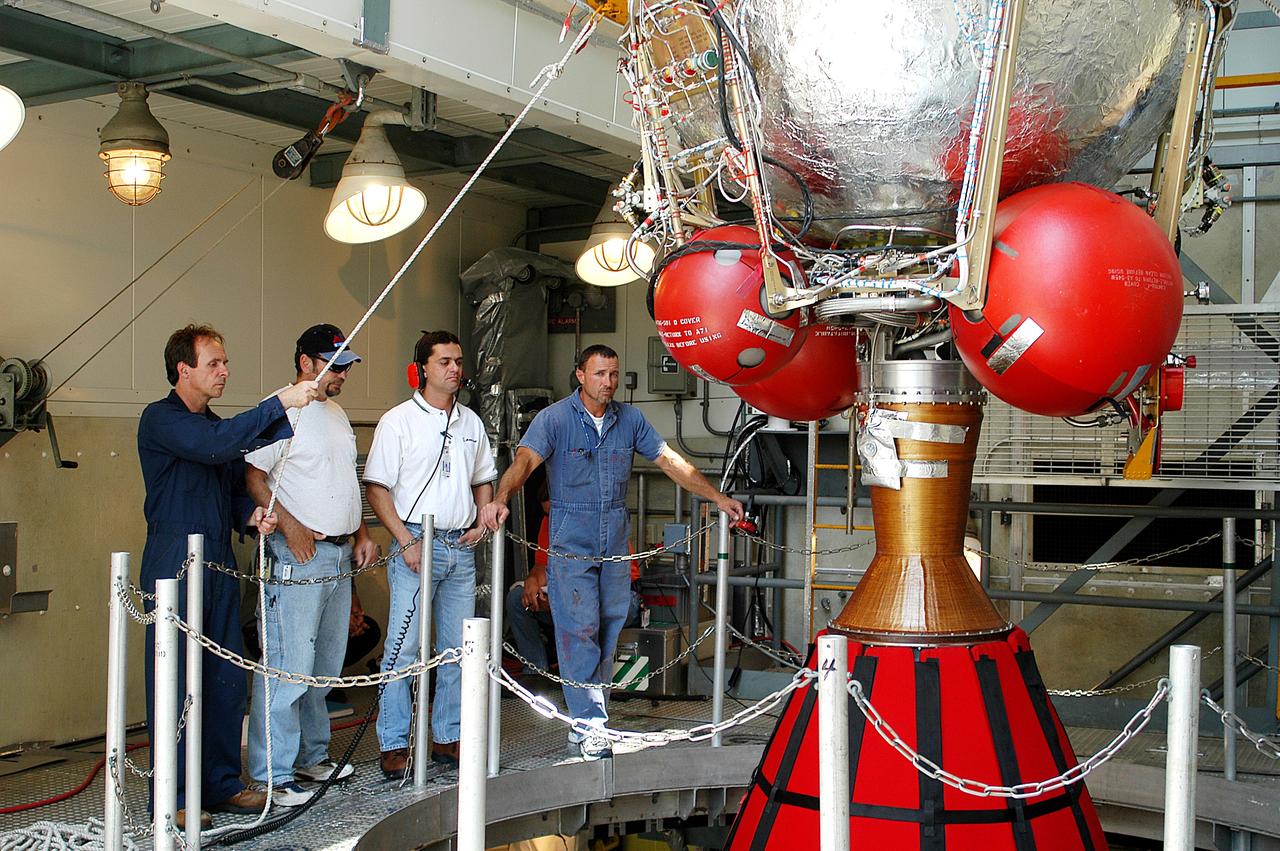
KENNEDY SPACE CENTER, FLA. - The second stage of a Delta II rocket is positioned above a first stage at the top of the launch tower on Pad 17-B, Cape Canaveral Air Force Station. Next, it will be mated to the first stage in preparation for the launch of the Mars Exploration Rover-1 (MER-B) on June 25. NASA’s twin Mars Exploration Rovers are designed to study the history of water on Mars. These robotic geologists are equipped with a robotic arm, a drilling tool, three spectrometers, and four pairs of cameras that allow them to have a human-like, 3D view of the terrain. Each rover could travel as far as 100 meters in one day to act as Mars scientists' eyes and hands, exploring an environment where humans are not yet able to go. The launch of MER-2 (MER-A) is tentatively set for June 8.
Open