VoidView.Space
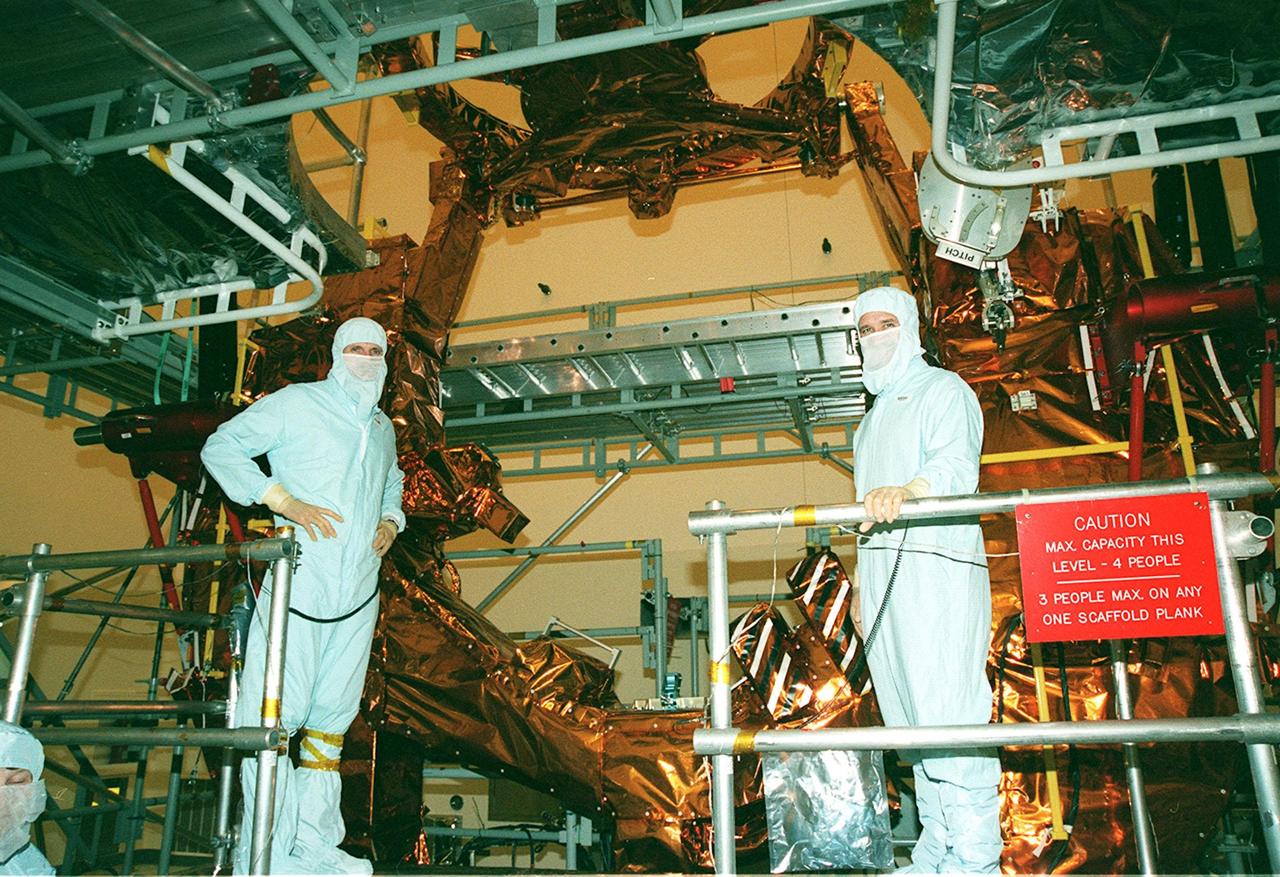
KENNEDY SPACE CENTER, FLA. -  The Payload is seen inside of the Bay just before the doors are closed for flight at KSC's Launch Pad 39A.   Discovery, the orbiter for the STS-82 mission, is ready for the launch of the second Hubble Space Telescope service mission.  The payload consists of the Near Infrared Camera and Multi-Object Spectrometer (NICMOS) that will be installed, Fine Guidance Sensor #1 (FGS-1), and the Space Telescope Imaging Spectrograph (STIS) to be installed. The STS-82 will launch with a crew of seven at 3:54 a.m. EST, Feb. 11, 1997. The launch window is 65 minutes in duration. The Mission Commander for STS-82 is Ken Bowersox. The purpose of the mission is to upgrade the scientific capabilities, service or replace aging components on the Telescope, and provide a reboost to the optimum altitude.

Telescopes — Page 28

KENNEDY SPACE CENTER, FLA. - The Payload is seen inside of the Bay just before the doors are closed for flight at KSC's Launch Pad 39A. Discovery, the orbiter for the STS-82 mission, is ready for the launch of the second Hubble Space Telescope service mission. The payload consists of the Near Infrared Camera and Multi-Object Spectrometer (NICMOS) that will be installed, Fine Guidance Sensor #1 (FGS-1), and the Space Telescope Imaging Spectrograph (STIS) to be installed. The STS-82 will launch with a crew of seven at 3:54 a.m. EST, Feb. 11, 1997. The launch window is 65 minutes in duration. The Mission Commander for STS-82 is Ken Bowersox. The purpose of the mission is to upgrade the scientific capabilities, service or replace aging components on the Telescope, and provide a reboost to the optimum altitude.

KENNEDY SPACE CENTER, FLA. -   At the KSC Launch Pad 39A, two members of the payload closeout crew check equipment as the doors are just about ready to be closed.  The Payload inside the bay of Discovery, the orbiter for the STS-82 mission, is ready for the launch of the second Hubble Space Telescope service mission.  The payload consists of the Near Infrared Camera and Multi-Object Spectrometer (NICMOS) that will be installed, Fine Guidance Sensor #1 (FGS-1), and the Space Telescope Imaging Spectrograph (STIS) to be installed. The STS-82 will launch with a crew of seven at 3:54 a.m. EST, Feb. 11, 1997. The launch window is 65 minutes in duration. The Mission Commander for STS-82 is Ken Bowersox. The purpose of the mission is to upgrade the scientific capabilities, service or replace aging components on the Telescope and provide a reboost to the optimum altitude.

KENNEDY SPACE CENTER, FLA. - At the KSC Launch Pad 39A, two members of the payload closeout crew check equipment as the doors are just about ready to be closed. The Payload inside the bay of Discovery, the orbiter for the STS-82 mission, is ready for the launch of the second Hubble Space Telescope service mission. The payload consists of the Near Infrared Camera and Multi-Object Spectrometer (NICMOS) that will be installed, Fine Guidance Sensor #1 (FGS-1), and the Space Telescope Imaging Spectrograph (STIS) to be installed. The STS-82 will launch with a crew of seven at 3:54 a.m. EST, Feb. 11, 1997. The launch window is 65 minutes in duration. The Mission Commander for STS-82 is Ken Bowersox. The purpose of the mission is to upgrade the scientific capabilities, service or replace aging components on the Telescope and provide a reboost to the optimum altitude.

Open

KENNEDY SPACE CENTER, FLA. -  Robert T. Nelson of KSC Security points to an approximately 24-foot-long crack on the Mobile Launcher Platform (MLP), which is holding the Space Shuttle Discovery en route to Launch Pad 39A for the STS-82 mission.  Nelson was riding on the MLP when he heard a loud noise and noticed the crack.  Rollout had begun shortly after 7 a.m. EST and was stopped at about 8:25 a.m.  This Y-shaped crack is on the MLP surface and runs from near the left-hand solid rocket booster flame hole toward the near corner of the MLP.  Rollout of Discovery resumed just past noon after structural engineers determined that the integrity of the MLP had not been compromised.  Discovery is scheduled to lift off on the second Hubble Space Telescope servicing mission on Feb. 11.

KENNEDY SPACE CENTER, FLA. - Robert T. Nelson of KSC Security points to an approximately 24-foot-long crack on the Mobile Launcher Platform (MLP), which is holding the Space Shuttle Discovery en route to Launch Pad 39A for the STS-82 mission. Nelson was riding on the MLP when he heard a loud noise and noticed the crack. Rollout had begun shortly after 7 a.m. EST and was stopped at about 8:25 a.m. This Y-shaped crack is on the MLP surface and runs from near the left-hand solid rocket booster flame hole toward the near corner of the MLP. Rollout of Discovery resumed just past noon after structural engineers determined that the integrity of the MLP had not been compromised. Discovery is scheduled to lift off on the second Hubble Space Telescope servicing mission on Feb. 11.

Open

KENNEDY SPACE CENTER, FLA. -  The Rotating Service Structure has been retracted at KSC's Launch Pad 39A.   Discovery, the orbiter for the STS-82 mission, is ready for the launch of the second Hubble Space Telescope service mission.  The payload consists of the Near Infrared Camera and Multi-Object Spectrometer (NICMOS) that will be installed, Fine Guidance Sensor #1 (FGS-1), and the Space Telescope Imaging Spectrograph (STIS) to be installed. The STS-82 will launch with a crew of seven at 3:54 a.m. EST, Feb. 11, 1997. The launch window is 65 minutes in duration. The Mission Commander for STS-82 is Ken Bowersox. The purpose of the mission is to upgrade the scientific capabilities, service or replace aging components on the Telescope, and provide a reboost to the optimum altitude.

KENNEDY SPACE CENTER, FLA. - The Rotating Service Structure has been retracted at KSC's Launch Pad 39A. Discovery, the orbiter for the STS-82 mission, is ready for the launch of the second Hubble Space Telescope service mission. The payload consists of the Near Infrared Camera and Multi-Object Spectrometer (NICMOS) that will be installed, Fine Guidance Sensor #1 (FGS-1), and the Space Telescope Imaging Spectrograph (STIS) to be installed. The STS-82 will launch with a crew of seven at 3:54 a.m. EST, Feb. 11, 1997. The launch window is 65 minutes in duration. The Mission Commander for STS-82 is Ken Bowersox. The purpose of the mission is to upgrade the scientific capabilities, service or replace aging components on the Telescope, and provide a reboost to the optimum altitude.

Open

KENNEDY SPACE CENTER, FLA. -  The White Room is seen at the upper left where the astronauts enter the Space Shuttle for flight.  The Rotating Service Structure has been retracted at KSC's Launch Pad 39A.   Discovery, the orbiter for the STS-82 mission, is ready for the launch of the second Hubble Space Telescope service mission.  The payload consists of the Near Infrared Camera and Multi-Object Spectrometer (NICMOS) that will be installed, Fine Guidance Sensor #1 (FGS-1), and the Space Telescope Imaging Spectrograph (STIS) to be installed. The STS-82 will launch with a crew of seven at 3:54 a.m. EST, Feb. 11, 1997. The launch window is 65 minutes in duration. The Mission Commander for STS-82 is Ken Bowersox. The purpose of the mission is to upgrade the scientific capabilities, service or replace aging components on the Telescope, and provide a reboost to the optimum altitude.

KENNEDY SPACE CENTER, FLA. - The White Room is seen at the upper left where the astronauts enter the Space Shuttle for flight. The Rotating Service Structure has been retracted at KSC's Launch Pad 39A. Discovery, the orbiter for the STS-82 mission, is ready for the launch of the second Hubble Space Telescope service mission. The payload consists of the Near Infrared Camera and Multi-Object Spectrometer (NICMOS) that will be installed, Fine Guidance Sensor #1 (FGS-1), and the Space Telescope Imaging Spectrograph (STIS) to be installed. The STS-82 will launch with a crew of seven at 3:54 a.m. EST, Feb. 11, 1997. The launch window is 65 minutes in duration. The Mission Commander for STS-82 is Ken Bowersox. The purpose of the mission is to upgrade the scientific capabilities, service or replace aging components on the Telescope, and provide a reboost to the optimum altitude.

Open

ksc-98pc-1671

ksc-98pc-1671

Open

KSC-08pd2957

KSC-08pd2957

Open

STS-82 Discovery moves toward Launch Pad 39A

STS-82 Discovery moves toward Launch Pad 39A

Open

TDRS-M Encapsulation

TDRS-M Encapsulation

Open

KSC-08pd1953

KSC-08pd1953

Open

KSC-08pd2780

KSC-08pd2780

Open

KSC-02pd0024

KSC-02pd0024

Open

TDRS-M Atlas V Second Stage Centaur Off-Site Vertical Integratio

TDRS-M Atlas V Second Stage Centaur Off-Site Vertical Integratio

Open

STS-125 Flight Controllers on Console - (Orbit Shift)

STS-125 Flight Controllers on Console - (Orbit Shift)

Open

TDRS-M Spacecraft Lift to Transport Vehicle

TDRS-M Spacecraft Lift to Transport Vehicle

Open

KSC-08pd1978

KSC-08pd1978

Open

KSC-08pd1957

KSC-08pd1957

Open

KSC-08pd2868

KSC-08pd2868

Open

KSC-98pc1439

KSC-98pc1439

Open

KSC-98pc836

KSC-98pc836

Open

KSC-08pd2423

KSC-08pd2423

Open

KSC-08pd1949

KSC-08pd1949

Open

KSC-08pd2429

KSC-08pd2429

Open

STS-125 MS3 Grunsfeld during EVA3

STS-125 MS3 Grunsfeld during EVA3

Open

KSC-08pd3650

KSC-08pd3650

Open